
Savant Systems is a company that continues to evolve to meet the ever-changing environmental conditions that challenge sustainable home design. Founded in 2005 by Robert Madonna, a telecommunications engineer whose goal was to create a more intuitive and user-friendly smart home software-driven control system than what existed at the time. Since its founding, the company continues to build on its successful implementation for improving the home living experience by developing and delivering graphical, touch-based control of lighting, audio/video, climate and security systems.
This early approach distinguishes Savant’s paradigm shift away from relying heavily on proprietary interfaces and less intuitive controls. Today, one of their focuses involves incorporating AI into whole-home integration and control.
“Savant has been a leader in delivering an unparalleled, personalized smart home experience for more than two decades, orchestrating lighting, climate, entertainment, security and other smart devices all from our multi-award-winning app,” explained Madonna. “Now, Savant’s AI-powered ecosystem will revolutionize the way customers around the world interact with their homes, positively impacting every aspect of their lives. Savant is dedicated to being a leader on that journey.”
Robert Madonna

I recently sat down with Bryce Judd, who joined Savant in 2024 as Chief Revenue Officer, Savant Systems and GE Lighting, to talk about his vision on the AI revolution and its transformative implications for the smart home industry. Very similar to Robert Madonna’s background, Judd’s early career was also telco that included more than 25 years of business experience in the technology, telecommunications and connected-home industries. In telecom, it was his work with mobile networks, content distribution, and the evolution of intelligent, self-healing networks that became foundational technologies and migrated into enterprise and residential environments.
Steve: Bryce, please share how your background plays into your outlook regarding AI and the smart home.
Bryce: My roles in the automated home industry provided a deep experience in professionally installed smart home platforms and the custom integration channel. I joined Savant taking on a key role in shaping the company’s technology strategy and vision, particularly around the future of AI-driven smart homes. It is motivating to collaborate with a team of forward-looking mindsets that are focused on how emerging technologies, especially artificial intelligence, large language models, and automation, can simplify complex systems, improve the homeowner experience, empower integrators, and transform how smart homes are designed, installed and supported. I believe AI will be one of the most transformative technologies ever, fundamentally reshaping how smart homes operate, how users interact with technology, and how the custom installation industry functions. I also see AI as a major disruptor, not just a trend. It is a “tsunami” of technological change that will impact virtually every aspect of our lives and industry. Past revolutionary technologies like mobile computing and network evolution, are the benchmarks, but AI will evolve more profoundly and rapidly. We’re going to a world very quickly where the technology will speak human as opposed to humans having to learn to speak technology. For the smart home market and experience, AI will define a new level of natural, human-centered interaction. Traditional smart home interfaces require users to learn the language of technology with specific commands, and syntax. With AI, users will instead speak naturally – “turn up the temperature a bit”, and the system will understand context, intent and preferences, reducing frustration and complexity.
AI will understand what “here” means, interpret qualitative phrases like what “a bit warmer” really means, recognize routines like “get the home ready for entertaining”, and respond appropriately across lighting, audio and climate. Home automation requires training models to “speak the language of the home” and understand device interactions, workflows and integrations unique to each environment. Savant’s AI work focuses on training proprietary models that understand its platform, third-party integrations, and how homeowners’ express intent.

Steve: Savant has built a legacy of development breakthroughs, is AI the next step?
Bryce: Yes, it is. When considering all the work the company has built as its foundation, this evolution in leveraging the power of AI is timely. The concept of Unified, App-Based Control, it was Savant that was an early leader in enabling full home control from a single mobile app, bringing lighting, climate, entertainment, security and shades into one cohesive interface. The visual development, Scene-Based Automation, popularized the use of customizable “Scenes” allowing multiple systems to respond together with a single command, simplifying complex home automation into everyday actions. We introduced TrueImage Lighting Control that expanded the visual approach to lighting control, empowering users with the ability to interact directly with images of their rooms, making lighting adjustments more intuitive than traditional sliders or menus. Supporting the installation professionals, Advanced Audio/Video Integration helped modernize whole-home entertainment by embracing IP-based audio and video distribution, enabling flexible, high-quality multi-room media control. It was our early Deep Apple and Voice Integration adoption of iOS, Siri and Apple ecosystem features that set Savant apart, allowing voice control, shortcuts and seamless interaction across Apple devices.
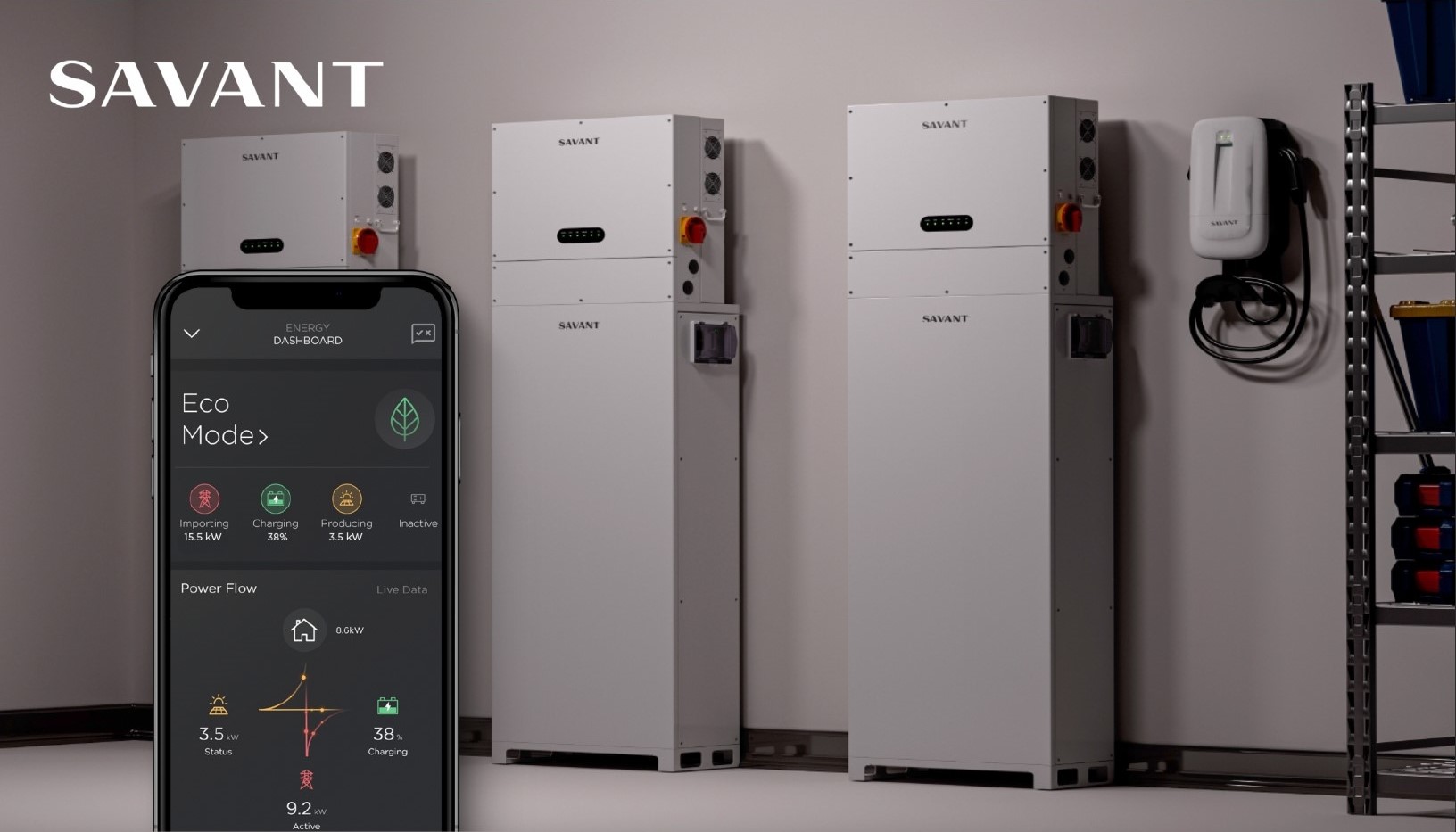
Cloud and Subscription-Based Enhancements introduced cloud-backed features such as system monitoring, configuration backups, and centralized dashboards, allowing systems to evolve through software updates rather than hardware replacement. Energy and Power Management is another timely example of breakthroughs with innovations like circuit-level energy monitoring and load management. Savant expanded home automation beyond convenience into efficiency and power optimization. Broad Third-Party Compatibility was important for Savant’s extensive device ecosystem that allows integration with a wide range of lighting, HVAC, security and entertainment products, preserving homeowner choice while delivering unified control.
Today, Savant is continuing its work, adopting artificial intelligence in a focused, practical way to enhance usability rather than replace human control. Its AI-related capabilities are primarily centered on voice control, contextual automation and system intelligence. By integrating with platforms like Siri and other voice assistants, Savant enables more natural, conversational commands and smarter execution of scenes and routines. Savant also uses AI-driven logic to improve context awareness, allowing the system to anticipate user needs based on time, occupancy, device status and usage patterns. This helps automate everyday actions, such as adjusting lighting, climate or entertainment, without constant manual input.
Savant’s aim and approach to AI emphasizes refinement and convenience, using intelligent software to make complex home automation simpler, more responsive, and more personalized. The journey that I think the industry has to be on is how do we translate all the legacy knowledge, the best practices, the experiences, and teach AI how to navigate that seamlessly.

Steve: You mentioned the system integrators which are your dealer base. How will they benefit from AI?
Bryce: We also recognize that by empowering integrators AI will not just benefit homeowners, it will augment technicians and integrators by guiding workflows, reducing mistakes, and enabling less experienced staff to perform at expert levels. AI will help accelerate the next new level of best install practices that will lead to faster installs, fewer callbacks and better business outcomes.
Steve: How will productivity development need to adapt?
Bryce: On the product development side of the equation, AI will help internal teams, like engineering, become more productive through accelerating development cycles and improving quality. Product development must be tied to the real-world deployment timeline and go-to-market strategy, because advanced AI features are not yet widely marketed or fully released, and the reason Savant plans measured, incremental rollouts are to avoid overwhelming users, but still introduce seamless and meaningful improvements.
The future vision will include more autonomous AI agents capable of interpreting patterns, anticipating homeowner needs, and providing proactive, personalized experiences while moving past reactive voice commands into true interactive intelligence.
Because AI is the next defining wave of innovation, it is essential to the evolution of smart homes, and companies that embrace and integrate it effectively will lead the industry. Savant is not just joining the AI trend, instead, it is leading the transformation of smart homes through deeply integrated intelligent automation.
Steve: Simply fascinating. Any additional thoughts you would like to share?
Bryce: The big picture view is that AI has the potential to be one of the largest disruptors of innovation to ever hit human civilization. And we are only at the very beginning of starting to contemplate and understand how AI will affect everything that we do. Savant will do its part in leveraging AI as much more than just a feature. AI will be the engine of the next generation of smart home experiences, and it is going to be more than just a voice interface. It is going to change the whole business model for the smart home professional, evolve, and redefine the smart home industry’s training and installation, lowering costs and improving profitability.