
Photo: Sherrill Furniture
The Pursuit of Faster
It feels like the world keeps moving faster and faster, as if picking up speed is no longer optional but a necessity. Faster is progress. It’s more efficient, more streamlined, more refined. It’s better. Faster has become an obsession for many, and in the pursuit of it, they pull the collective along with them, careening down the autobahn barely halfway strapped in.
Faster is the goal. It gets you, or anything you need, where it needs to be more quickly. It increases production, expands access and drives consumption. If you’re the fastest, it can even put you at the top of the podium with a gold medal.
Moving faster also leaves less time to correct direction, to think, and to make decisions. It forces quicker reactions, leans on familiarity, encourages assumptions, and reduces the time for questioning, all of which increases the likelihood of error. Much of this is by design, driven by those who benefit from speed. The result is often decisions that feel right in the moment but, quite literally, don’t hold up over time.
Fast food came first, then fast fashion, and fast furniture followed. Fast food was a revolution of convenience, built on speed of service. It wasn’t originally created to be cheap, that was simply its evolution. This is a pattern the human psyche struggles to resist when progress and profit intersect. First, make it faster. Then, make it cheaper. Finally, make it replaceable.
We moved from home-cooked meals to processed convenience. From hand-me-down clothing that was passed down and remembered in family photos, to garments that are treated as disposable. From furniture built to last generations, to pieces that struggle to survive even a move across the room. To sell more, you must produce more.
According to the Netflix documentary Buy Now: The Shopping Conspiracy:
- Every second 12 tons of plastic is created
- Every minute 190,000 garments are produced
- Every hour 2.5 million shoes are produced and 68,733 phones are made
- But get this key datapoint: Every day 13 million phones are thrown away
In relation to home furnishings, according to the EPA, the acceleration of fast products is evident in our industry. 12.1 million tons of furniture and furnishings are discarded annually, a number that is up 450 percent since 1960. Of that total, more than 80 percent end up in landfills, with little to no opportunity to be upcycled or have their life extended.
That is the current reality of manufacturing efficiency. And it raises a fundamental question for the design industry. Are we creating and specifying furniture that consumers will take pride in, or just becoming temporary custodians of the landfill’s waste?
“There was no other organization tackling sustainability in home furnishings. So, in 2006, at High Point Market, a group of home furnishings professionals and key stakeholders came together with a shared realization that no one was addressing sustainability within the industry in a meaningful way and knew they needed to do something.”
A Voice for the Industry
For generations, furniture was, at its core, about wood. Material choices were simple: solid hardwoods like oak, walnut, maple, cherry and mahogany, along with others like ash and birch, and occasionally softer woods like pine.
Fast furniture, at its core, is a mix of wood fibers bound with formaldehyde-based resins, layered with plastic laminates, synthetic foams, and chemical finishes that can release Volatile Organic Compounds (VOCs) into the air. Fast furniture composition reads more like the back of processed food packaging than the solid wood foundation the furniture industry was built on. Which is why not only does the industry need a steward, but the environment also needs a voice.
“We were born in a showroom,” says Scarlette Tapp, Executive Director of the Sustainable Furnishings Council. “There was no other organization tackling sustainability in home furnishings. So, in 2006, at High Point Market, a group of home furnishings professionals and key stakeholders came together with a shared realization that no one was addressing sustainability within the industry in a meaningful way and knew they needed to do something.”
What started with around 50 members quickly grew into a broader network across manufacturers, suppliers, retailers and eventually designers, all working toward a common goal of reducing the industry’s negative impact on the environment and human health. Tapp, however, didn’t come into that mission from within the industry.
“My background had really been serving nonprofits in various sectors, from healthcare to the arts, Nature Conservancy, and so forth,” she says. Her experience wasn’t rooted in furniture or manufacturing, but in building organizations around purpose. “I wasn’t coming in as a furnishings insider,” she adds. “But I was really excited about shaping the organization so that it could reach its potential with its mission.”
One of their most impactful initiatives is the Wood Furniture Scorecard, developed in partnership with the National Wildlife Federation. The program evaluates retailers on their wood sourcing practices, from simply having a policy in place to tracking certified or reclaimed wood usage and publicly disclosing targets.
“We developed a very transparent methodology that awards points all the way from having a sourcing policy to setting public goals,” she says. “It’s a really good look at how companies are actually performing.” When asked about interior designers, Tapp explains, “Interior designers really sit in a very special place to move this industry in terms of sustainability. They operate at the intersection of product and consumer, influencing not only what gets specified, but how those choices are understood and valued.”
That realization led the Sustainable Furnishings Council to invest heavily in designer-focused education. Programs like Green Leaders were built to give designers the knowledge and language to bring sustainability into their work, not as a niche add-on, but as a core part of the design process. “That training program really helped move designers to not only educate themselves but take that education to the end-user,” she says.
Tapp also points to younger generations as a potential turning point. “I think the younger generations are more aware,” she says. “They’re more curious and more willing to question what they’re buying. Many are already leaning toward vintage, secondhand and more sustainable alternatives. I think they’re going to be the ones to really turn the ship.
“It is important. It’s responsible and it’s good business. Through partnerships and industry relationships, the goal is not just awareness, but action”
Where Design Comes Together
If petroleum-based synthetic foam is the combustible fuel of fast furniture, then e-commerce is the torch that ignited it. It has created a machine that moves relentlessly, accelerating both production and the message behind it. Cheaper, faster, easier. Buy now but forget that you’ll need to replace it soon. It has changed the way we buy and the process behind it. Decisions are now made from images, dimensions, delivery timelines and star ratings, not craftsmanship and firsthand knowledge.
Consumers have reinforced this by buying products online that are manufactured the fastest, shipped the easiest, cost the least, and follow the latest trends pushing them to replace something they likely recently purchased or is already falling apart. But quality furniture was never meant to work that way. Quality is a business model not built on being replaced.
For the next generation to make the difference Scarlette Tapp hopes for, they need an industry that supports them and provides a bastion for quality, where future designers can turn for both product and education, shaping how they can sustainably specify throughout their careers. Which is why a counterbalance to fast furniture is so important, not something that exists digitally in the cloud, but something physical and tangible, a place that represents a tradition of quality that can be seen, touched and experienced on a visceral level.
That beacon is the home furnishings markets, comprising High Point Market in High Point, North Carolina, Las Vegas Market, and Atlanta Market, all owned and operated by ANDMORE and led by CEO Jon Pertchik. Jon is carrying on the legacy built by his predecessor, Bob Maricich, who orchestrated the merger of all three markets beginning in 2011. When he stepped into the role, he immediately saw a deeper connection between the people and the product, a connection built not just through generations of tradition but through generations of families who pass it along. “There’s something really special about these multigenerational family businesses and how relationship-driven it is,” he says.
High Point Market dates back to 1909, with the International Home Furnishings Center opening in 1921. Over the past century, it has become the backbone of not only the home furnishings industry but also interior design, so it makes sense that High Point was the origin of the Sustainable Furnishings Council and that it is important to Jon and ANDMORE to be active members of the association.
Sustainability, in Pertchik’s view, isn’t a single initiative or program, it is a shared responsibility that runs across the entire industry. “It’s important, it’s responsible, and it’s good business,” he says. He points to the role organizations like the Sustainable Furnishings Council play in helping align that thinking. “Through partnerships and industry relationships, the goal is not just awareness, but action.”
In an era where purchasing furniture is increasingly digital, Pertchik sees the physical experience as more important than ever. “There’s something about discovery,” he says. “You walk around a corner, you see something for the first time, you touch it, you feel it.”
When it comes to fast furniture, he says, “You don’t even really know what it’s made of. Some of the products are made with things that you may not want your kids around, formaldehyde and other adhesives that aren’t good from a health standpoint.”
In a system driven by speed and convenience, the negative health and environmental impacts are cloaked behind a well-orchestrated veil, leading consumers to overlook the consequences, even when making decisions about things that may affect them for years to come. Part of the solution, Pertchik believes, lies in education and transparency. Markets play a role in that by creating spaces for conversation, panels and direct engagement between buyers and manufacturers.
But perhaps more importantly, designers play a role. “They’re the ones advising their customers,” Pertchik says. “They’re building trust. And through that trust, they can shift behavior and understanding.”
“You can make something more sustainable, but if it doesn’t last, you haven’t solved the problem”
Sustainable Furniture Starts with Durability
If speed and cheap materials define one side of the industry, craftsmanship defines the other. For Tom Zaliagiris, Senior Vice President of Sales for Sherrill Furniture, that distinction is anything but theoretical. He grew up in the furniture business, spending his early years in factories and learning the trade from the ground up. His career has taken him through both domestic and international manufacturing, including time managing production facilities in Asia.
For Tom, the decision to join Sherrill Furniture wasn’t just about taking another role, it was about aligning with something that still felt true to what the industry was meant to be. Sherrill represented a different model, one rooted in craftsmanship, domestic manufacturing and a long-term view of quality. At a time when much of the industry was shifting toward speed and cost, the company remained committed to building furniture the right way in North Carolina, with an emphasis on materials, construction and people. That alignment mattered because the human element matters.
“At the end of the day, for us this is a craft,” he says. At Sherrill Furniture, that craft is central to the company’s identity. The production process is driven as much by people and craftspeople as it is by systems. “You can maintain a machine,” he says. “You can’t replicate the psychology and skill of a craftsman.”
That distinction shows up in their product. Fast furniture, as he defines it, is built to meet a need. It serves a purpose in the moment, often driven by price, convenience and the dopamine hit received from instant consumption. Sherrill furniture, by contrast, “It’s something you’re proud to have in your home,” he says. That pride is tied to longevity and that difference has a direct impact on sustainability.
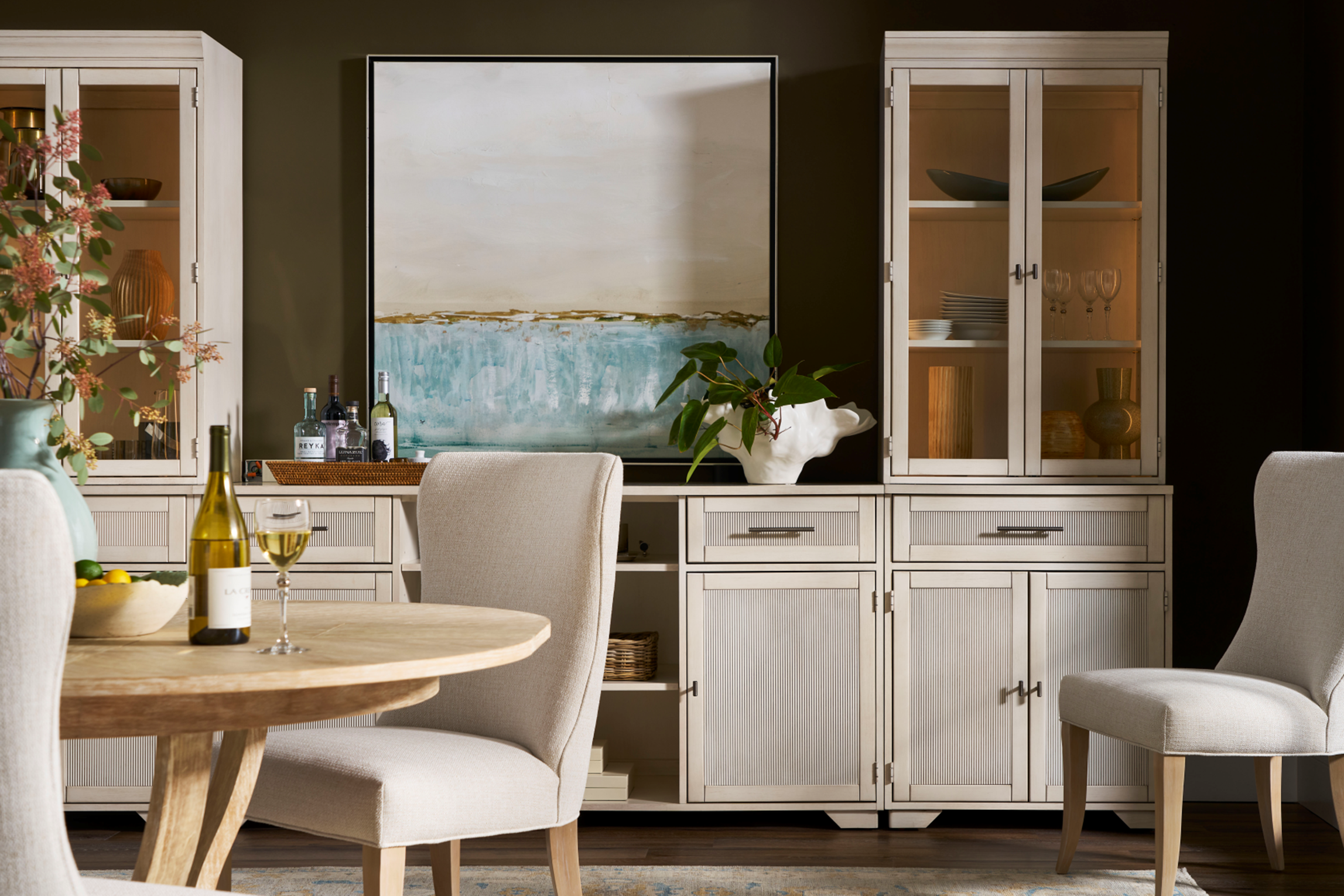
Quality products don’t happen by accident, they come from the people, processes and standards behind them. Sherrill has made deliberate investments in materials and processes that support sustainability. More than 90 percent of the steel used in production comes from recycled sources. The furniture cushions themselves incorporate soybean oil into the foam to reduce reliance on petroleum-based inputs while still maintaining comfort, support and long-term performance. Fabrics are sourced with an emphasis on recycled or natural fibers, and wood is supplied through responsibly managed forestry systems. Even production waste is managed with intention, including the reuse of sawdust to heat facilities during colder months.
But Zaliagiris is clear that these efforts must work together with quality materials and construction of the product. “You can make something more sustainable,” he says, “but if it doesn’t last, you haven’t solved the problem.”
The Responsibility We Carry
Across all three perspectives, a common theme emerges. Responsibility is shared. Manufacturers shape materials and processes. Markets shape access, exposure and education. Designers shape decisions and public understanding. Consumers shape demand. Each plays a role. And each has both an opportunity and responsibility.
For designers in particular, that opportunity is significant. They are the ones bridging the gap in the design industry between manufacturer and consumer. They are the ones explaining value, providing their knowledge on sustainability, and shaping how spaces not just come together, but will last together. In a world driven by speed, that role becomes even more important.
Because slowing down, even slightly, can change the outcome for all of us.