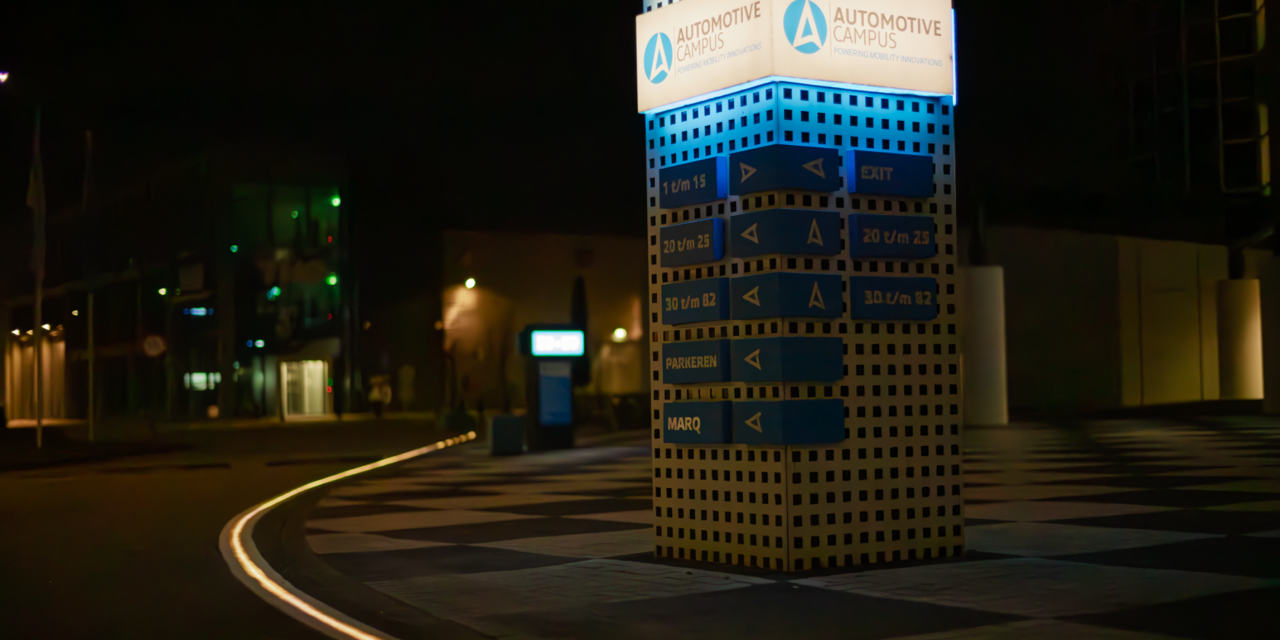
Dutch deep-tech company Luxene has successfully deployed the world’s first operational patent-pending active luminous guidance line integrated directly into road markings at the Automotive Campus in Helmond. The pilot was implemented in collaboration with Automotive Campus, road marking specialist Tpaint, and infrastructure partner Heijmans, within the campus innovation environment. This deployment marks the first time that road markings themselves function as an active optical guidance system in real infrastructure, transforming passive markings into intelligent infrastructure that actively guides road users in darkness, rain, and poor visibility. The milestone comes as Luxene prepares to exhibit its technology at Intertraffic Amsterdam 2026, the world’s leading trade event for mobility infrastructure, where the company has been selected as a nominee for both the Intertraffic Startup Award 2026 and the Intertraffic Aspiration Award 2026, recognizing breakthrough innovations shaping the future of mobility and infrastructure.
Solving a fundamental safety gap in infrastructure
Road markings are among the most critical safety elements in transport infrastructure, yet they rely entirely on reflection from vehicle headlights. In darkness, rain, fog, or snow, their visibility is significantly reduced or lost entirely. More than half of fatal traffic accidents occur at night or in low-visibility conditions, despite lower traffic volumes. Traditional solutions rely on mast-mounted lighting to illuminate entire environments, consuming significant energy while contributing to light pollution, ecological disruption, and infrastructure cost. Luxene addresses this challenge fundamentally differently. Instead of illuminating the surroundings, Luxene embeds continuous active light guidance directly into the road marking itself, ensuring that the path remains clearly visible exactly where it is needed, independent of external lighting conditions.
Creating a new category of intelligent infrastructure
Luxene’s patent-pending system uses specialized optical fibers integrated into certified road marking materials to transmit light from externally housed, serviceable units. This proprietary architecture ensures that no electronics are embedded in the road surface itself, dramatically improving reliability, durability, and scalability while protecting Luxene’s core intellectual property. The pilot demonstrates how infrastructure can evolve from passive visual elements into active guidance systems.
Luxene’s Guidance Light Lines Pilot
Maarten Tobias, CEO and co-founder of Luxene, said: “This pilot marks a fundamental shift in infrastructure. For the first time, road markings actively generate guidance instead of passively reflecting light, enabling safer roads with minimal energy use and environmental impact. At the same time, pilots like this are essential for learning and refinement, and this deployment is already providing valuable insights that help us further optimize the system for large-scale infrastructure use.”
Validated in Europe’s leading smart mobility ecosystem
Automotive Campus is internationally recognized as a leading Living Lab environment for mobility and energy system technologies. The campus provides a real-world environment for validating next-generation infrastructure solutions alongside advanced mobility and energy systems, including connected and autonomous vehicle technologies. Sascha Bloemhoff, Managing Director, Automotive Campus Helmond, said: “Automotive Campus accelerates breakthrough innovations in mobility and energy by enabling real-world validation. Luxene’s Guidance Light Lines show how infrastructure itself can become intelligent, adaptive, safer and more sustainable. They are a great example of the mini-society we are offering to test in a real-world environment. We are excited to support this world-first pilot and its role in shaping the future of smart, safe and sustainable mobility.”
Seamless integration using existing road marking materials and processes
A key objective of the pilot was to validate that Luxene’s patent-pending Guidance Light Lines can be installed using existing certified road marking materials, application techniques, and infrastructure processes. The installation was successfully completed using standard application equipment and proven road marking methods, confirming compatibility with current infrastructure workflows. Camiel Taminiau, CEO, Tpaint, said: “This pilot demonstrates that Luxene’s Guidance Light Lines can be applied using our certified road marking materials and established application techniques. The installation was smooth and fully compatible with existing marking processes, confirming that this innovation can be integrated into real infrastructure without requiring fundamental changes.” Henri Nas, Director Road Specialisms, Heijmans, said: “From an infrastructure integration perspective, this pilot confirmed that Luxene’s solution can be deployed efficiently using existing construction and installation processes. The implementation was straightforward and aligned well with standard infrastructure practices, demonstrating its readiness for broader deployment.”
Significant advantages over traditional infrastructure
Luxene’s patent-pending Guidance Light Lines provide continuous active visibility independent of vehicle headlights, ensuring reliable guidance in darkness and adverse weather conditions. The system reduces energy consumption by up to 30 percent compared to traditional mast lighting while minimizing light pollution and preserving dark skies. Because all active components are housed outside the road surface, the solution improves durability, reduces maintenance, and enables scalable deployment using existing road marking materials and application processes.
Enabling safer and future-ready mobility, including autonomous driving
The pilot on campus grounds demonstrates how road infrastructure can evolve from passive markings into active guidance systems that improve safety today while supporting future smart, safe and sustainable mobility technologies. Research has shown that autonomous and assisted driving systems relying on camera-based perception are significantly affected by low light, rain, fog, and snow conditions where traditional reflective markings become difficult to detect. Luxene’s active luminous guidance lines provide clear, consistent visual references under these conditions, supporting both human drivers and machine vision systems. Luxene’s externally powered and digitally controllable architecture enables infrastructure that is not only more efficient, but also adaptable and ready for integration with next-generation intelligent mobility systems.
From pilot to broader deployment
This pilot marks Luxene’s transition from technology development to real-world deployment. The company’s patent-pending Guidance Light Lines provide a scalable solution for roads, cycling infrastructure, industrial environments, airports, ports, logistics hubs, and smart mobility corridors. Luxene will showcase its technology at Intertraffic Amsterdam 2026, where its nomination for both the Intertraffic Startup Award 2026 and the Intertraffic Aspiration Award 2026 reflects growing international recognition of its potential to redefine infrastructure guidance and road safety.