


By David Cohen
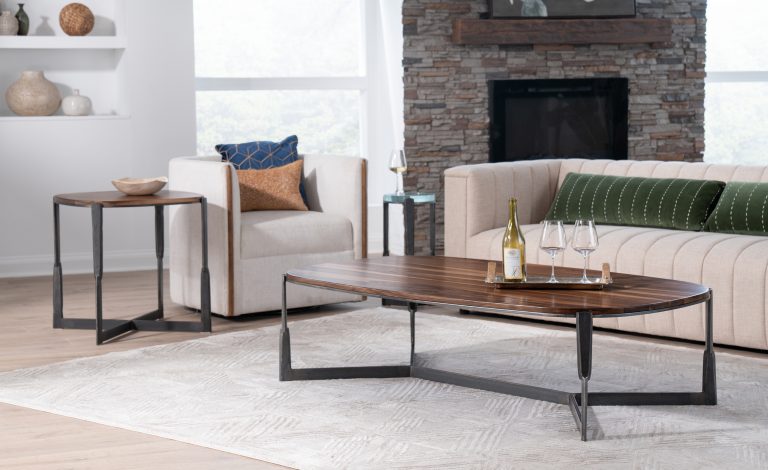
Photos: Charleston Forge
Every piece that builds the story of Charleston Forge begins and ends within a tight circle around Boone, North Carolina. This is an American company that treats blacksmithing as both an art and a vocation, measures sustainability in miles and generations, and says yes to transforming nearly any idea you can sketch into an heirloom for your home.
Tucked in the rolling hills of the Blue Ridge Mountains, Charleston Forge has spent the last four decades shaping steel into art. Known for its hand-forged furniture, meticulous craftsmanship, and American-made story, the company has built a reputation on authenticity and care, a rarity in a world of mass production.
At it’s core, Charleston Forge is about more than furniture. It’s about people, artisans who still shape metal by hand and heat, leadership grounded in respect and culture, and a belief that the best things are built to be sustainable for generations.
We sat down with Dan Minor, President of Charleston Forge, to talk about the company’s roots, its sustainable footprint, its artisans, and the enduring value of American craftsmanship.

“Steel gives us both strength and flexibility,” Dan explains. “It’s durable, it’s beautiful, and it represents permanence. That’s what we want our furniture to stand for.”
Roots Forged in Steel
Charleston Forge was founded in 1984 by Art and Susan Barber, who began not with furniture, but fireplaces. They crafted fire screens and tools, beautiful, functional pieces of steel, but the work was seasonal. Seeing an opportunity, they set out to use their metalworking skills in a way that could sustain year-round.
Recognition came quickly. “They started making a few pieces of furniture,” recalls Dan. “When they took those first designs to High Point Market, the Spiegel catalog spotted one of their baker’s racks and featured it on the inside cover. That put Charleston Forge on the map.”
At that time, a placement in Spiegel could launch a brand, connecting American-made craftsmanship with households that valued quality and design. For Charleston Forge it did just that and marked the beginning of a journey built on that very connection.
The company’s name pays homage to a long tradition of craftsmanship. Though proudly based in Boone, North Carolina, the name “Charleston Forge” was inspired by the historic ironwork adorned throughout Charleston, South Carolina, much of it forged by the renowned blacksmith Philip Simmons, whose intricate gates, balconies and fences help define the city’s architecture.

A Sustainable Carolina Legacy
North Carolina has long been known as the heart of American furniture making, and Charleston Forge’s location in Boone anchors it deeply in that heritage. “North Carolina became a hub for furniture for two reasons,” Dan explains. “There were great natural resources, and the transportation lines are excellent.”
For Art and Susan, both graduates of Appalachian State University, Boone was home and the right place to grow. Today, Charleston Forge operates two facilities in the state. Their forge in Boone is the heart of steel fabrication, where solid bar, tube and laser-cut components are heated, hammered, bent, welded and finished. About an hour away, their wood plant in Morganton crafts tabletops and case goods, joining Appalachian hardwoods with American-made steel.
“It’s not just about convenience,” Dan says. “It’s about identity. This area has an energy, a sense of pride in making things. You feel that in every piece that leaves our shop.”
That sense of local heritage also drives Charleston Forge’s sustainability efforts. Around 90 percent of their materials come from within a hundred miles of their facilities, steel from Hickory, glass from Mount Airy, wood from Morganton, and 100 percent from within the United States. Each mile matters, fewer miles mean fewer emissions. “From the moment we source materials to the time a piece leaves our factory, sustainability is part of the conversation,” Dan says. “That’s a huge part of our story. Our carbon footprint is small because our supply chain is local and our process is clean.”
“We use propane because it’s the cleanest burning fuel,” Dan says. “And we powder-coat every piece because it’s the cleanest way to paint, aerosol goes in the air, liquid goes into streams, and powder is recycled and used over and over again.”
Even the packaging reflects that care for the environment. A custom box-making machine cuts each carton to the exact size of the piece, minimizing waste. Nearly all the wood Charleston Forge uses for their tops and cabinetry comes from forests certified by the USDA as growing at a rate of three trees for every one harvested, ensuring that the Appalachian landscape continues to thrive.
But for Dan, sustainability goes beyond distance and materials. “The biggest part of our sustainability story,” he says, “is that we make generational furniture. There’s no reason our pieces should ever end up in a landfill.”

A Leader Shaped by Experience
Dan Minor’s own journey into furniture was unexpected. After college, he began in the grocery business, a practical start, but not a passionate one. “A friend told me I’d be good at sales,” he laughs. “So, I took a job at Boyle’s Furniture, which at the time was one of the top 100 retailers in the country. I ended up staying there for almost twenty years.”
When Boyle’s eventually closed, Dan’s long relationships with manufacturers led him to Charleston Forge. “I started as sales manager in 2014,” he recalls. “After five years, I became president. It’s been an incredible experience. I get to work with talented people and help lead a company that still believes in the value of American craftsmanship.”
His leadership philosophy is simple: respect. “Regardless of what someone does, whether they’re welding, grinding or working in shipping, I want them to feel valued and appreciated.”
That philosophy isn’t just words, it was put to the test and proven by one of Charleston Forge’s largest clients, Starbucks, during an ethical sourcing audit conducted with all their partners. “Every employee they interviewed said they felt valued,” Dan says. “A perfect 100 percent. Starbucks told us they’d never seen that before. That was one of my proudest moments.”

Forging a Modern Artisan Culture
Within Charleston Forge’s walls, the echo of hammer and steel creates a rhythm and tune that feels timeless, reverberating through the Blue Ridge like the fighting pulse of a craft that once was, and should always be.
Every day, artisans gather here not just to build furniture, but to shape something lasting. “The people who come through our doors,” Dan says, “take real pride in what they do.”
That pride shows in every detail. Whether forging hot metal or planing wood, each piece carries the maker’s touch. No production lines hum here; every leg, joint and curve is shaped and welded by hand.
“The only people we hire with experience are welders,” Dan explains. “No one walks in saying, “I’m a blacksmith.” We teach them. They learn how to heat the steel to 1,200 degrees, then hammer it into shape using a pneumatic hammer. Every taper, every curve you see is done by a person, not a machine.”
That human touch is what defines Charleston Forge. “We’ve had people who started here and fell in love with the craft,” Dan continues. “They go home and make their own knives and decorative pieces. They’ve learned a true skill, something that connects them to centuries of metalworkers before them.”
The Language of Material
At Charleston Forge, material is more than medium, it’s identity. “Steel gives us both strength and flexibility,” Dan explains. “It’s durable, it’s beautiful, and it represents permanence. That’s what we want our furniture to stand for.”
The company’s patina process, a hallmark of its finishes, combines heat, oxidization and artistry. Some pieces are heated, hammered and quenched in water, giving them subtle tonal variations that tell their own story. “No two pieces ever look the same,” Dan says. “That individuality is part of what makes our furniture feel alive.”
Charleston Forge offers around fifteen powder-coat finishes and six hand-painted options. After the metal is formed and coated, artisans glaze and paint each piece by hand, layering color and texture to create depth and warmth. The result is a process that blends the precision of modern manufacturing with the soul of traditional craftsmanship. “There are a few tricks of the trade that make our product look interesting,” Dan adds, “but every one of them comes down to a person’s hand and eye.”
Carolina Hospitality
For Charleston Forge, hospitality isn’t just how you treat people, it’s in how you make things. In the design world, hospitality is also synonymous with durability. At Charleston Forge, that spirit lives in the strength of every weld, creating furniture and statement pieces built to last, perfect for hotels, restaurants and high-traffic spaces. As the company puts it, “Our furniture is beautiful, but it is designed to be used, not pampered.” It’s a philosophy that makes Charleston Forge a natural fit for the hospitality world.
That blend of craftsmanship and endurance has earned Charleston Forge partnerships with brands that demand both beauty and strength. “Starbucks came to us for their community tables, those long, heavy tables you see in their stores,” Dan recalls. “They weren’t from our catalog; we designed them specifically for them. The same goes for Panera. They needed tables that could handle constant use and still look good doing it.”
Charleston Forge’s ability to customize each design or just start from concept has made it a trusted partner for countless hotels, wineries and event venues. “We love being part of those environments that bring people together,” Dan says.

That spirit of collaboration extends beyond hospitality. “We build OEM steel components for about a dozen other furniture makers,” Dan explains. “They may not have the capability to make metal bases or parts, so we do that for them. We don’t see it as competition, it’s community, supporting other makers who share our values.”
Charleston Forge stands firm in its commitment to American-made manufacturing. “It’s not just a label,” Dan emphasizes. “It’s who we are.”
That dedication has given the company an edge in uncertain times. While tariffs and global supply chain disruptions rattled much of the industry, Charleston Forge never had to adjust pricing or delay orders. “Our customers were getting weekly price increases from importers,” Dan recalls. “We didn’t change our price once. It made a difference.”
The company’s evolution continues. In 2023, Charleston Forge entered the kitchen and bath market with a line of luxury vanities, a natural fit following the launch of its new glass division. In 2024, the acquisition of McKenzie Dow, another family-owned, high-end furniture maker, added advanced woodworking capabilities, allowing for complete mixed-material collections in metal, glass and wood.
Charleston Forge continues its legacy at one of the places it began, High Point Market, the center of the American furniture world. Twice a year, the company introduces new designs that balance form and function, grounded in craftsmanship yet current in style. “We’re always evolving,” Dan says. “We bring out fresh ideas, but we never compromise on the integrity of how something is made.”
That openness to collaboration reflects Charleston Forge’s core philosophy that craftsmanship is a shared journey. Whether it’s a blacksmith in Boone or an interior designer in New York City, every piece begins with dialogue, blending vision, material and skill.
“Authentic. Enduring. American.” Those are the three words Dan uses to describe the company. They summarize not just a brand, but a belief system. When asked what he hopes people feel when they encounter Charleston Forge furniture, Dan doesn’t hesitate. “I hope they feel quality,” he says. “When they lift it, they know it’s solid. When they see it, they see the care that went into it. And when they call us, they speak to a real person who’s proud of what we do.”