
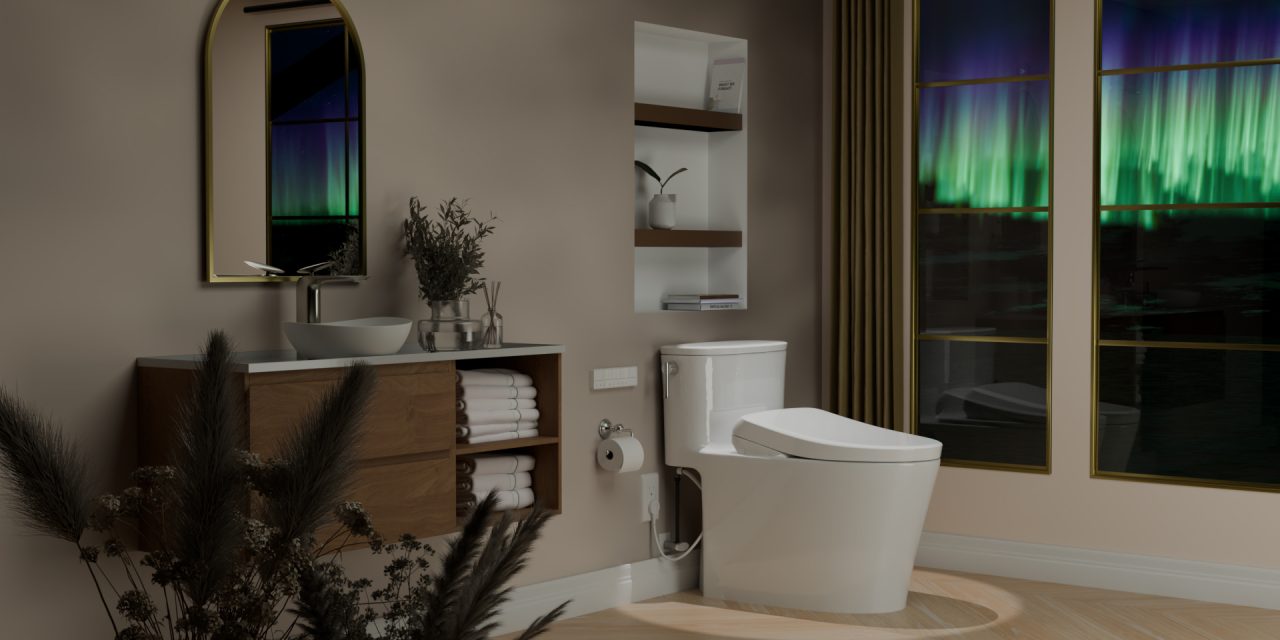
There are very few products that can go viral on social media, earn a coveted spot on a Drake-gifted pedestal at a trade show, and simultaneously carry real-world implications for water conservation, and global sustainability, all while being something you use every single day. But that is exactly where TOTO finds itself.
After the Kitchen and Bath Industry Show, I sat down with William Strang, President of Corporate Strategy, eCommerce & Retail for TOTO USA, to talk about the company’s latest engineering marvel: the Aurora toilet. What began as a conversation about flush mechanics quickly expanded into a wide-ranging discussion about carbon disclosures, aging demographics, a $230 million investment in American manufacturing, and how a rapper from Miami set off 1.2 billion impressions for a toilet brand.
The Problem With the Pond
To understand why the Aurora exists, you have to understand the trajectory of water conservation in the United States and the engineering challenge that comes with it.

“Historically, we’ve been moving from 3.5 gallons down to 1.6 gallons, down to 1.28 gallons, which is the U.S. EPA WaterSense standard for their lowest recommended level,” Strang explains. “And there are some regions going even lower: dual flush, one-gallon flush toilets.”
That push toward reduced flush volumes creates a familiar problem for anyone who has wrestled with a dual-flush toilet. The water spot, or as Strang calls it the “pond,” gets smaller as flush volumes decrease. A smaller pond means a larger exposed bowl surface, which means the kind of residue that even a full flush can struggle to clear. And in a world where municipalities are continuing to mandate lower flush volumes, a toilet that requires a second flush or leaves a less-than-clean bowl is a problem waiting to happen.
TOTO’s answer is what they call INTEGRAVITY technology, or more precisely, Intelligent Gravity.
It is a system that uses no electricity and relies entirely on the physics of moving water and gravity to accomplish something the plumbing industry has not cracked before: a thorough, sequential, rim-to-bowl clean with a single low-volume flush.
How INTEGRAVITY Works
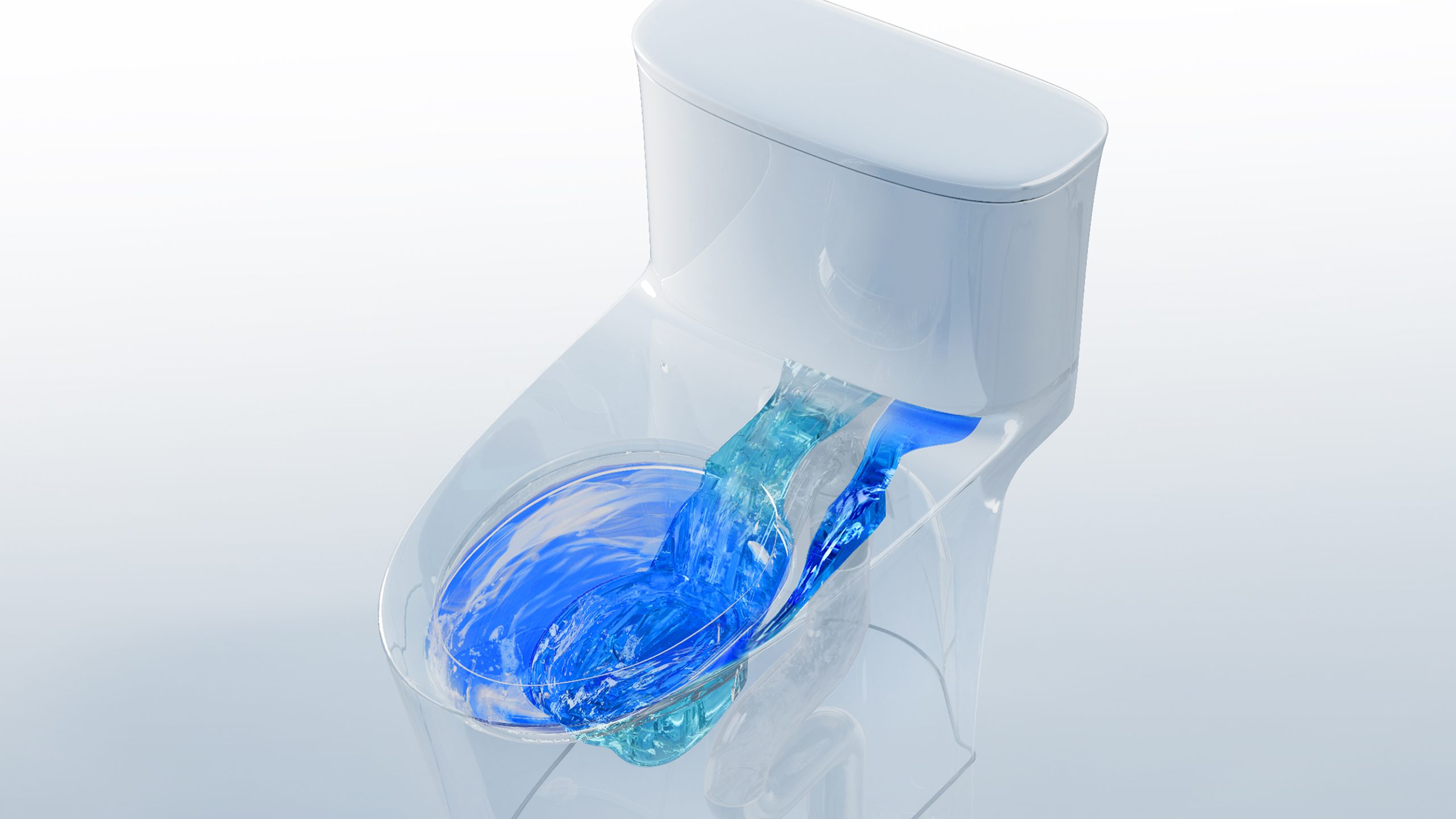
The Aurora uses a dual-valve system housed inside a conventional gravity-fed tank. When you flush and walk away, the toilet takes over in two distinct phases.
First, a rim wash valve activates, spinning water around the upper bowl for three full seconds, scrubbing the surface clean before any evacuation begins. Then, a separate siphon jet fires beneath the pond, drawing waste through the trap and into the sewer line in a single pull. As the bowl refills, the rim wash continues for an additional ten seconds, ensuring that anything disturbed during the flush is fully rinsed down and the bowl is left in ready condition for the next use.
“We’ve actually used gravity flush toilets, tank toilets with no power associated with them, that allow the water to flow through the bowl in this long, spinning wash,” Strang explains. “You’ve flushed. You’ve closed the lid. You’re walking away. And the toilet does what it needs to do.”
For builders, designers and specifiers operating in water-stressed markets like Arizona, New Mexico and California, this is not a luxury feature. It is futureproofing. TOTO designed the Aurora to perform cleanly at 1.28 gallons today, with architecture that holds up as mandates push the threshold to one gallon and below.
“We know that incrementally, municipalities and states are going to continue to push down on water conservation,” Strang says. “We want to make sure that whatever you put in that bowl is going to go down with every flush, without you having any concerns or worries about it.”
Sustainability With Receipts
TOTO’s commitment to environmental stewardship goes well beyond flush volume specs. The company participates in the Carbon Disclosure Project (CDP), an internationally recognized framework in which over 25,000 companies worldwide submit detailed environmental data for independent review. The CDP rates companies on water stewardship, forestry and climate sustainability.
TOTO holds an A rating in two of the three CDP categories, placing the company in the top 1.5 percent of participating organizations globally. To put that in context, the CDP roster includes Ford, General Motors, major paper companies, and listed exchanges. Getting to the top tier requires not just good intentions but validated, auditable data.
“You’re not just blowing sunshine up someone’s skirt,” Strang says plainly. “You have to tell that story with a level of authenticity, but with validation.”
Beyond CDP, TOTO has developed Environmental Product Declarations (EPDs) for its toilet lines, a full lifecycle carbon accounting that tracks every unit from raw clay extraction through firing, shipping, consumer use and eventual disposal. Critically, TOTO measures the embedded energy content of each gallon of water consumed over the product’s lifetime, calculated at 0.0037 kWh per gallon, and factors that into the total carbon footprint of each flush.
“Your carpet doesn’t actually consume a resource during its life,” Strang notes. “Our product consumes a resource every time you visit the bathroom. And that resource has an embedded energy cost that we measure, track and disclose.”
The commercial scale of this math is staggering. Strang points to Hartsfield-Jackson Atlanta International Airport, with 110 million passengers annually, as a case study in where small per-flush savings add up to massive environmental impact. “That’s where you can make a real dent,” he says.
Health, Aging and the Washlet Conversation
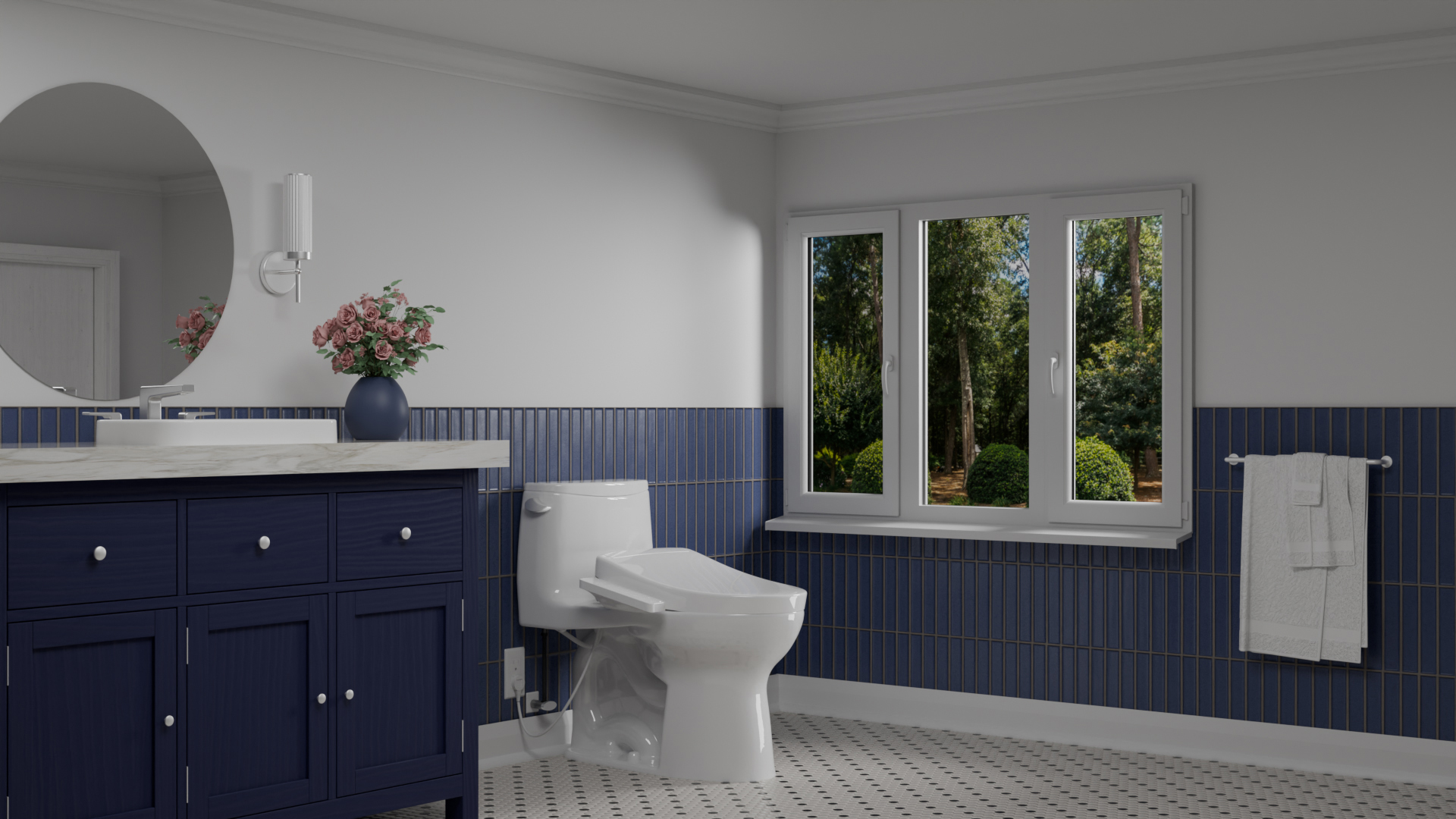
The Aurora is a toilet, but the conversation around it quickly extends to TOTO’s broader product ecosystem, particularly the Washlet bidet seat, which has its own compelling case in health and accessibility markets.
Strang speaks with visible conviction about the role TOTO’s Washlet products play in UTI (urinary tract infection) prevention, particularly among aging populations who may have diminished dexterity or who rely on caregivers for toileting assistance.
The caregiving angle resonates particularly in the context of nursing home and assisted living environments, where independent hygiene directly affects both quality of life and care burden. TOTO has already placed Washlets in care facilities with measurable results, not only for residents, but for caregivers who are relieved of some of the most invasive aspects of personal care.
“We can tell you what we hear from our customers. We want to not just tell the story. We want to validate it,” he says. “Individuals lose ambulatory or dexterity skill sets as they typically would toilet and use toilet paper to clean themselves. If that moves forward, it can be a serious problem, for women in particular. These tools are important.”
1.2 Billion Impressions and a Very Good Birthday Present
No article about TOTO’s current cultural moment would be complete without the DJ Khaled story.
For years, Drake, a longtime TOTO enthusiast with the company’s products installed throughout his Canadian properties, had been extolling the virtues of the brand to DJ Khaled. Khaled, perpetually interested but never quite committed, kept putting it off. Then, on Black Friday, a delivery truck arrived at Khaled’s Miami home with four of TOTO’s highest-end NEOREST units as a birthday gift from Drake.
What followed was an Instagram video in which Khaled narrated every feature with wide-eyed disbelief, called out his assistant to explain the functions, and declared his undying gratitude to Drake and to TOTO. The video reached 32 million followers and generated 1.2 billion impressions through the hip hop community.
“Our graph wasn’t large enough to accommodate the traffic spike,” Strang recalls with a laugh.
The episode illustrates something TOTO has leaned into deliberately: the idea that a premium bathroom product can be both aspirational and attainable, and that the right kind of authentic endorsement, even from an unplanned, unsponsored source, can reshape an entire brand’s demographic profile overnight.
“We want to make this not only omnichannel but omnipresent,” Strang says. “You can buy the super high-end toilet that DJ Khaled got, or you can buy an entry-level Washlet at Costco for the price of a dinner out in New York.”
The omnichannel strategy spans Costco, Home Depot, Lowe’s, Amazon and a network of kitchen-and-bath showrooms where expert staff can walk customers through the full product line and connect them with plumbers and tile professionals who can handle the install. Every entry point leads to the same product ecosystem.

Built in Atlanta, Built to Last
TOTO recently completed a $230 million manufacturing facility just south of Hartsfield-Jackson Atlanta International Airport. The investment is the latest addition to a U.S. production footprint that began in 1991, and Strang describes as a deliberate part of the company’s sustainability strategy. Building domestically is not just good optics. It meaningfully reduces the carbon load associated with container ship transport from Southeast Asia, which relies on some of the dirtiest fuels in global logistics.
The new facility runs with heavy automation and robotics, increasing throughput while keeping production closer to its primary market. But what Strang wants to talk about just as much as the machinery is the people running it.
More than 40 nationalities are represented on the factory floor, with seven languages spoken among the workforce. TOTO offers on-site English language instruction as part of its employee development program, and Strang speaks about this with the kind of pride that has nothing to do with a press release.
“We’ve had folks come in from other countries who don’t speak a lot of English,” he says. “We can give them a job. We will teach you how to do the work. We will teach you English as well.”
The proof came during a recent factory tour with a visiting British hydraulics company. As the group moved through the plant, one of TOTO’s workers stopped them with a simple answer to a simple question about what it was like to work there. “Oh, I love TOTO,” she told them. “It changed my life.”
It was the moment in the interview when Strang, the industrial engineer who can rattle off dual-flush siphon jet mechanics without missing a beat, got a little emotional. The executive stepped aside and the human being showed up.
What’s Next
The Aurora is just launching as this article goes to print. Research partnerships are in development. The CDP reporting cycle continues.
TOTO’s long game is not complicated, but it is ambitious: demonstrate that sustainability and quality are not competing values, and that a product designed to last longer, use less water, and clean more effectively is also the more profitable one, the healthier one, and the smarter investment for builders, homeowners and commercial developers alike.
“Technology for technology’s sake, that’s not the point,” Strang says. “Technology that improves the experience overall is key to what we’ve seen in our society continuing to grow and prosper and reduce consumption across our entire ecosystem.”
He grins. “Water is our business. And we want to manage that water effectively.”


