ON A RECENT TRIP TO JAPAN, I was reminded yet again of how many shapes and forms progress can take. For me, Japan is a magical and mysterious place, full of order, creativity, and an unspoken concentration to detail. While the heyday of Japanese electronic design and production often seems to have passed, subtle innovations still abound, some of the best of which are out of public view.
In January 2015, I stayed with my dad at a new Mitsui Garden Hotel in the Ginza district of Tokyo. After 14 hours of travel, I put my bags down and hung my coat. Next, I slid open the ever-smooth water closet door and was gently greeted with some low-key Japanese robotics in the form of a sensor-driven, auto-lifting toilet lid.
I had long known about the Toto Washlet of my childhood memories, the strange toilet that had a bidet and seat warmer built in (which was crucial in my grandparents’ chilly mountain home). But this new era model was efficient, elegant and most importantly, intuitive. Despite my new-found love, I never took note of who created this amazing machine that makes the mundane task of waste management an experience in fine technology and design. On my most recent adventure, however, it finally clicked.

Lixil is a massive corporate brand the average American who doesn’t follow Japanese tennis star Kei Nishikori, or watch Japanese rugby, has probably never heard of. Lixil is a self-proclaimed Link to Good Living and a titan in Japanese building materials and home appliances. Now operating worldwide, some of Lixil’s oldest brands date back over 100 years.
Take INAX for example. INAX has been developing ceramic tile technology since 1924. Its founders served as ceramic tile advisers to the iconic Imperial Hotel in Tokyo designed by Frank Lloyd Wright. INAX has historically rivaled Toto in producing Japanese toilet bidets but began its journey into antibacterial ceramic technology at the end of WWII. Fast forward 75 years, INAX is now part of Lixil and has a long history producing award-winning, self-cleaning, sensor-driven bathroom fixtures.
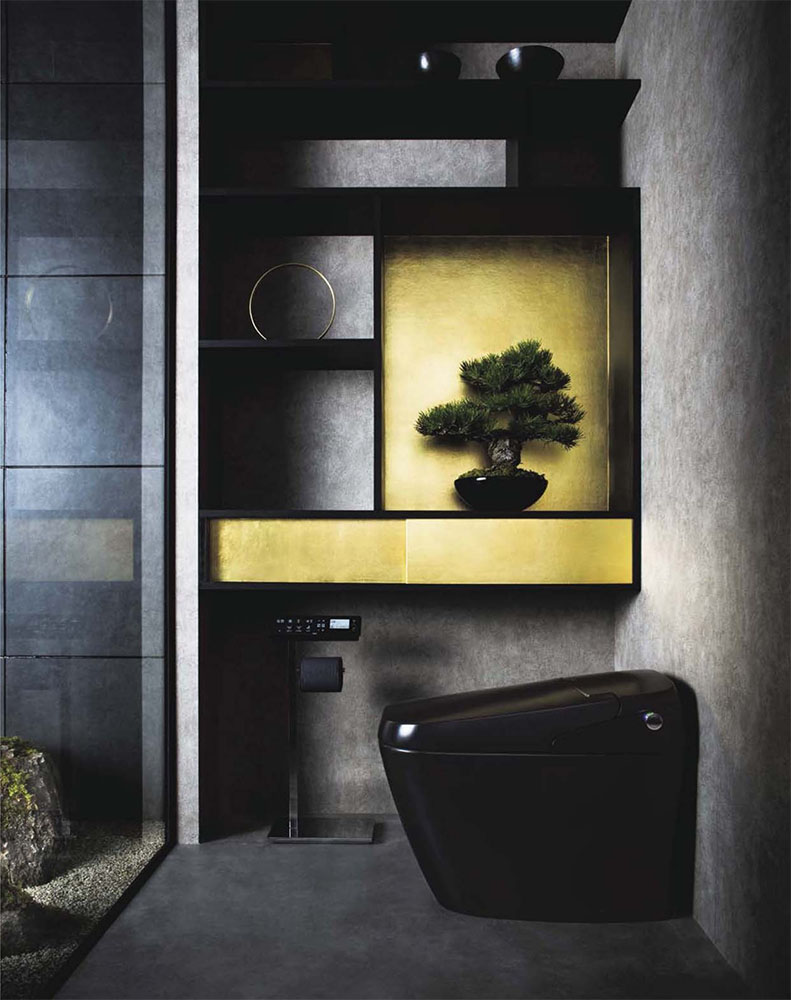
INAX was ultimately the century old group behind the self-lifting, Tokyo toilet lid I encountered in 2015 as well as the ones I experienced on my latest trip. To add to the already amazing ambiance of a toilet welcoming you into the small, intimate space that is a Japanese bathroom, the latest models included LED lighting behind, below and within the toilet bowl itself. They retained all the core functions of the previous generation (heated seat, posterior and feminine wash and dry, antibacterial self-cleaning bowls and nozzles, two levels of flush) and added a couple of new tricks. These units followed each use with a timed quick burst of circulated air and deodorizer (after you leave the room of course). And to top it off, on the newly designed wall-mounted control, there was now a button to lift and lower the seat itself.
Many Japanese designs are now tank-less or include cabinetry that hides the most visually unappealing aspects of a toilet, while also providing storage space.
The stigma surrounding bidets in America is a discussion I’m not convinced anyone really wants to read about (or that I want to write), but the long-standing opposition to such units becoming popular in the U.S. now has rather serious environmental implications. According to a recent study by the NRDC (National Resource Defense Council), Americans consume 20 percent of the global share of toilet paper while occupying only four percent of the population. A single roll requires upwards of 40 gallons of water to produce. Add in the effects of deforestation, pulping emissions, chlorine bleaching, a global shipping supply and the destruction of wildlife and indigenous communities, and we are talking about an increasingly dark industry — quite the contrast to the soft fluffy product portrayed in commercial ads.
However, setting aside traditional tissue’s environmental effects, there’s still the issue of progress. Why have American toilets failed to really progress in their quality, functionality and design? Is it just because we don’t want to use what is widely perceived as a French invention and therefore all toilets must remain the same? While heated seat additions and other after-market accessories have become more visible in the online shopping era, there has been little to no movement in terms of mainstream integration within new development, whether it be residential or commercial. Beyond the personal wellness benefits, many Japanese designs are now tank-less or include cabinetry that hides the most visually unappealing aspects of a toilet, while also providing storage space. These subtle changes in design seem obvious, but American manufacturers appear to be indifferent.