A flag bearing the EDGE34 brand flutters at the edge of the lot. Concrete seating, tables and sculptural planters dot the exterior of the building. It looks less like an exterior showroom display and more like a courtyard pulled from a boutique hotel or a private resort terrace, a scene waiting for people to experience it, to slow their day down for a minute and appreciate it.
The showroom sits in the shadows of what is arguably the global epicenter of the furniture industry. Millions of square feet of showrooms wait patiently for the next surge of designers, buyers and specifiers who flood the city for just two weeks every year to attend High Point Market.
Among thousands of brands built around wood, metal and upholstery, EDGE34 stands apart. Its foundation formed in San Francisco through the partnership of a U.S. and Belgian couple, one an interior designer (Kim Spencer) and the other a creative (Philip Damocles).
In an industry where many things are set in stone, they chose to set its U.S. presence and distribution in concrete, signaling a long-term commitment to High Point and the design industry rather than a seasonal appearance.
“I’ve been going to High Point my entire career,” says Kim Spencer, Co-Founder of Artisan Concrete Design Studio. “It’s the design capital. It’s where the industry connects. So, for us, it made sense to establish ourselves here.” Unlike seasonal showrooms that make up most of High Point Market, EDGE34 operates year-round, serving designers, hospitality firms, and landscape architects with convenient U.S. product distribution for their factory.

A Factory in the Jungle
Philip Damocles, who through study and relentless experimentation, became a master concrete artisan and mold maker. Mentored by Buddy Rhodes, widely regarded as a pioneer of the modern artisan concrete movement, Philip developed a deep understanding and respect for the material. At the same time, Kim, guided by her design perspective and instinct for material and form, began to see an opportunity for concrete to play a more meaningful role within the design industry. That shared vision would ultimately take root more than 1,600 miles South.
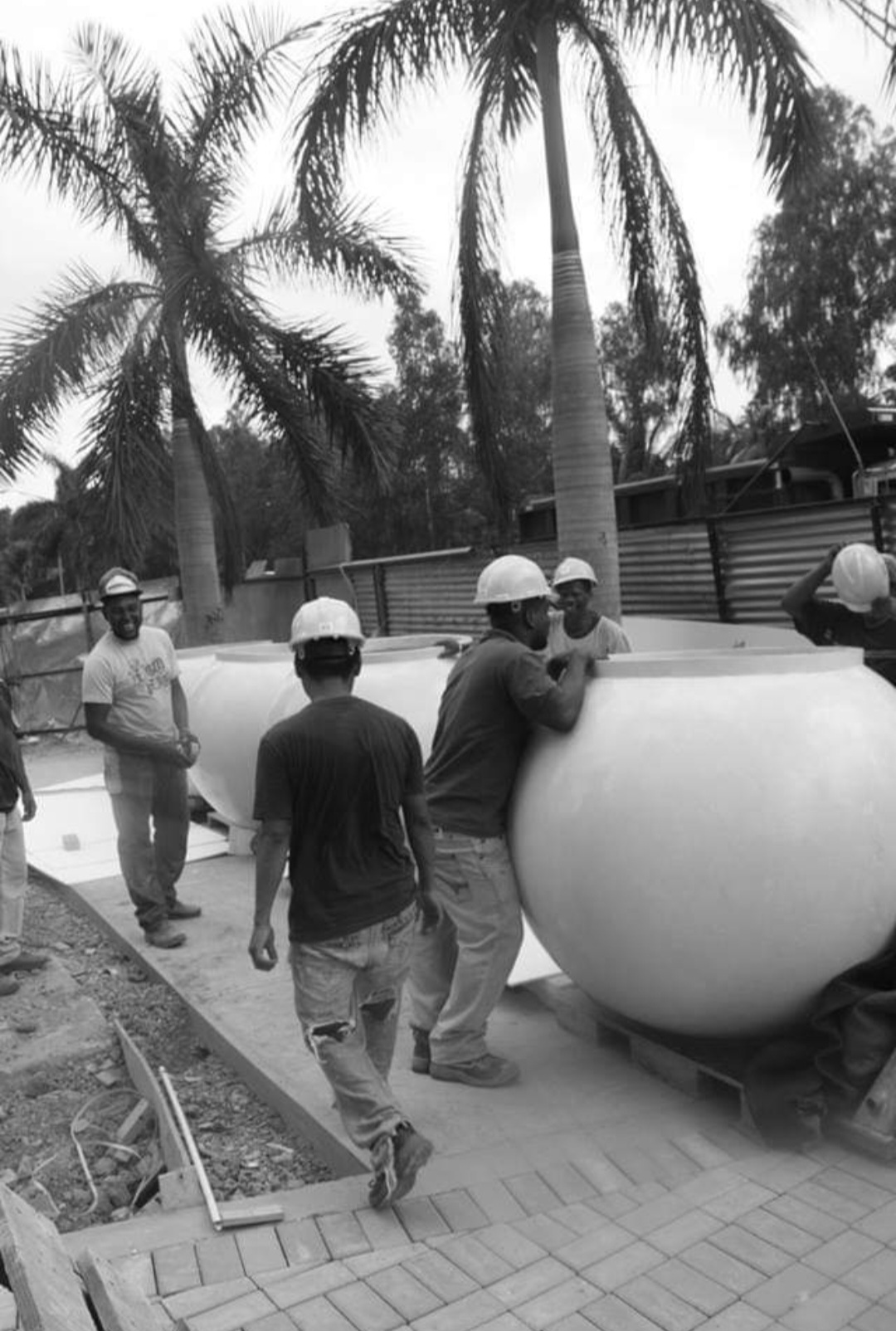
In a humid pocket of jungle outside Panama City, in an area known as Veracruz, sits Artisan Concrete Design Studio. Built with open-air walls and surrounded by dense greenery, the space absorbs the essence and lushness of the jungle. Monkeys move through the trees just beyond the walls, as if showing up for a day of work. Light filters through the canopy and across the machinery, where artisans hand-cast concrete from molds using techniques refined over two decades.
“There was nothing here when we started,” says Kim Spencer. “We created everything. We had to learn how to make our own molds, find all the resources locally, and build the systems ourselves.”
Often misunderstood as a purely tropical and rural country, Panama has also developed a thriving metropolitan center in Panama City, filled with luxury high-rises, hotels and mixed-use developments. As the premier concrete manufacturer in the country, many of those landmark urban projects are enhanced by architectural furniture and planters fabricated deep in the jungle. At its core, their story reflects a broader truth about modern craftsmanship. Artisans exist everywhere in the world, often far from traditional manufacturing centers. Some of the highest-quality products emerge from unexpected places.
Building for Time
The process, she emphasizes, is closer to chemistry than carpentry. Every ingredient must be weighed precisely. Temperature, humidity, curing time, fiber ratios, and mold construction all influence the final performance of a piece. “It’s really an alchemy,” she says. “We found our right formula, and we know that when we cast a product, it’s going to last.”
Concrete continues curing and gaining strength for decades. When properly formulated, sealed and maintained, it can perform for generations. Kim describes their pieces as heirloom products, not in a sentimental sense, but in a practical one. These are objects designed to stay in place, to weather use, climate and time without cycling into landfill after a few seasons.
“We’re not interested in making disposable furniture,” Kim says. “These pieces are meant to live with people, with properties, with projects, for decades.”
Traditional concrete furniture often brings to mind heavy public park tables, but modern artisan concrete furniture has evolved significantly. Fiber reinforcement now allows thinner, hollow forms without sacrificing strength, reducing material use, weight and waste.
At the end of a product’s life cycle, concrete can be crushed and reused as aggregate for new pieces. While cement production does carry carbon intensity, responsible manufacturing practices, durability, reduced replacement cycles, and material recyclability contribute to a more balanced environmental profile when evaluated over the full life of a product.
At Artisan Concrete Design Studio, water usage is actively managed to collect and recycle wash water from production processes, reducing runoff and conserving resources. Every improvement over time has come from problem solving on the factory floor. “The last 20 years have been a lot of problem solving,” Kim says.

Collaboration as Catalyst
To assist with expanding distribution into the U.S., the company has begun collaborating with designers and artists on licensed collections. For Kim, this brings fresh perspective and creative energy into a craft that can otherwise become inward-focused.
These partnerships introduce perspectives internal teams often never imagine on their own. They sharpen storytelling, expand visibility, bring new audiences, and push manufacturers technically, driving meaningful product evolution.
“To bring in outside voices has infused us with new excitement,” she says. “It pushes us to translate ideas we wouldn’t generate ourselves.”
Story in Form, Sam Mangakahia
The collaboration with cultural artist and product designer Sam Mangakahia brings a different kind of energy into the brand, one centered on story, symbolism, and connection.
Sam lives in Hawaii, though his creative roots stretch across the Pacific. Raised in a household where both parents were artists, creativity was woven into daily life, and as a child, he instinctively gravitated toward pattern, form and carving.
At eleven years old, boredom sparked the moment that began his path. Surrounded by ukuleles in his family home, Sam picked one up and etched a pattern into the wood using a butter knife. He did not play the instrument at the time; he was just drawn to the surface.
From there, everything became a canvas.
That instinct also foreshadowed his first licensing deal with a ukulele company, a full-circle moment that led to a custom piece for Dwayne “The Rock” Johnson and evolved into one-of-a-kind guitars for artists such as Post Malone and Jelly Roll. His ability to create not just designs, but story and content, also opened the door to collaborations with global brands like Disney.
Sam’s design philosophy was mentored under Māori master carver Rangi Kipa in New Zealand, where he apprenticed on major public projects and learned the discipline of form, proportion, refinement and cultural responsibility.
“The most important thing to me in design is the story it carries,” Sam explains. “What it can influence and inspire.” Even when viewers do not know the story, they feel something meaningful, creating curiosity that turns into connection.
This philosophy made the collaboration with EDGE34 a natural extension of his work.
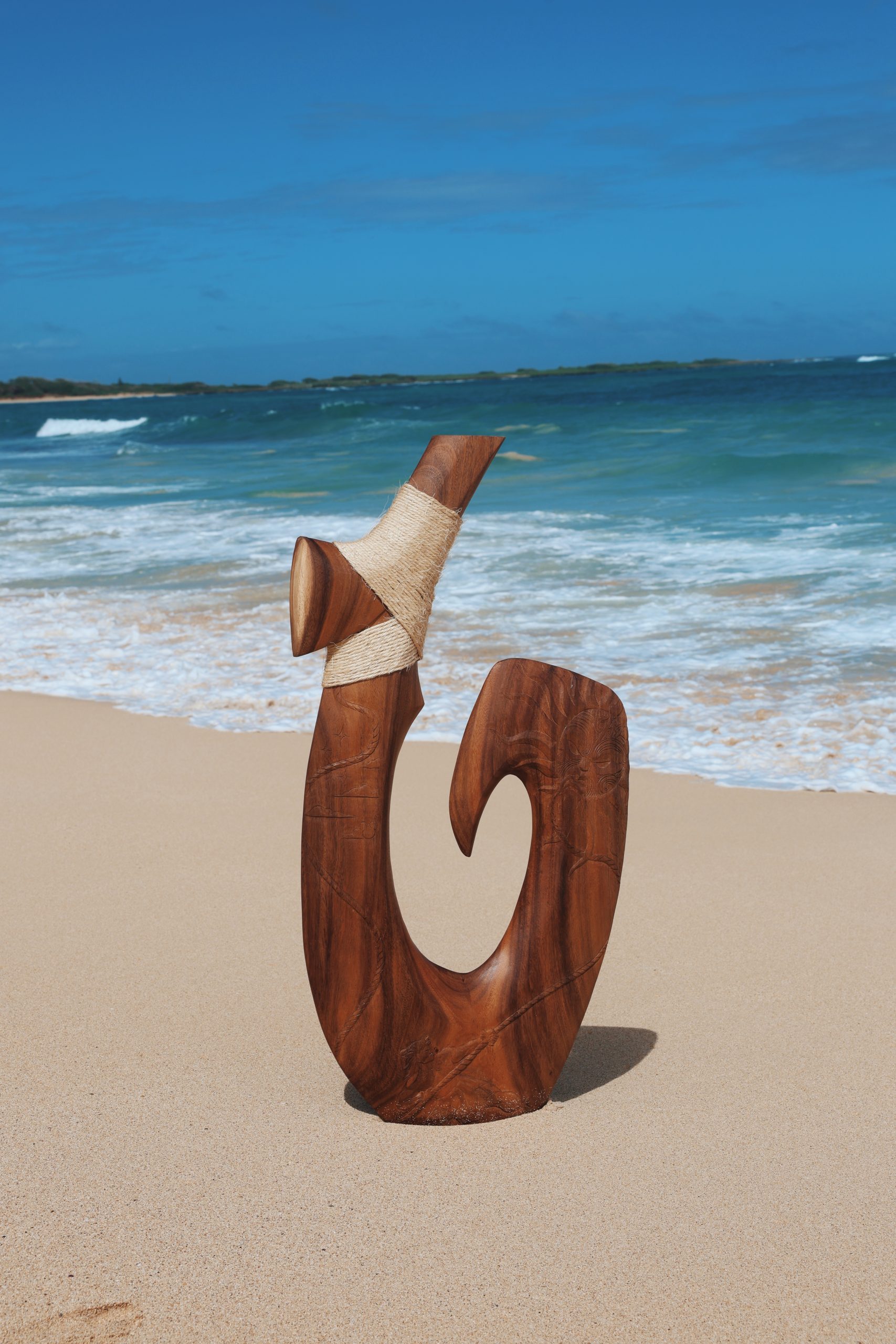
“Sam is an artist in the pure sense,” Kim said. “His designs are incredibly organic and completely unique in their shape. He pushed us into territory we hadn’t explored.” Sam had designed an abstract interpretation of Tangaroa, the Māori god of the ocean. The design represents what he describes as the “heart of the ocean” or its pulse. Curves echo shells, marine life, wave energy and natural flow.
“There was a lot of back and forth,” Spencer explains. “With a piece like this, the negative space is just as important as the positive space. We had to think through balance, structure, mold complexity, and how the piece would actually live in the real world. It was much more technically demanding than most of what we’ve done.”
“That’s also what we loved about it,” Spencer says. “We got to make something that has never been done before and expand our limits.”
This created a seven-foot-long sculptural seating experience that stuns equally as artwork as it does furniture. “When you get to see it at this scale, it’s extremely fulfilling,” Sam says. The result only helps validate his belief that cultural storytelling and modern architectural environments do not need to exist separately.
“We shape the buildings, and then the buildings shape us,” he notes. “There’s space in design for more story, more meaning.”
Sam believes companies that avoid outside collaboration risk creative stagnation. He compares it to music, where many of the most influential songs emerge from collaboration rather than solo work. Without external voices, brands may remain competent, but they often miss opportunities for unexpected fusion, expanded reach and cultural impact.

Structural Modernist, Tym De Santo
Tym De Santo has not arrived at being a product designer through a conventional doorway. His career arc reads more like a series of creative reinventions which all form a whole, professional skiing, musician, architecture, reality TV, furniture design, to name just a few. As a teenager living in England, he found himself captivated by heavy, monolithic concrete buildings many people dismissed as unattractive. “I loved those kind of brutalist structures,” he recalls. “They felt powerful. They felt grounded.” At the time, it was simply instinct and what drew him in.
Concrete moved well beyond fascination when Tym designed his own modern villa, inspired by the classical Italian villas tied to his family heritage. The project drew unexpected attention, media coverage and public curiosity. “That house kind of kicked off something I didn’t imagine,” he says. “People wanted to know about it.”
That appetite for experimentation brought him into the public eye early in his design career when he landed on Season One of HGTV’s Design Star after responding to a Craigslist casting post and submitting a YouTube audition video. He ultimately placed third in the competition, gaining national exposure and a platform that accelerated his transition deeper into design. The experience reinforced taking creative risks and trusting instinct.
His relationship with concrete remains both emotional and technical. One of his earliest concrete experiments, a steel table anchored by a concrete cone, still sits in his personal collection decades later. Concrete, to Tym, represents permanence, weight and authenticity. “It grounds things,” he says. “There’s something fascinating about the permanence of concrete, but also the idea that it can eventually be pulverized and return to the earth.”
That perspective is what drew him to EDGE34. Tym was struck not only by the sculptural forms, but by their dedication to the process. “They’re not inclined to cut corners,” he says. “For a designer motivated by pushing ideas forward, the opportunity to collaborate with a manufacturer that respects craft, engineering, and material integrity was essential.”
The piece Tym is launching with EDGE34 this Spring is called Grimaldi, named after a crater on the moon. The sculptural lounge chair features a carved interior that references lunar terrain, dramatic yet engineered for comfort. The design is intentionally modular. Multiple chairs can be paired, rotated, or clustered into configurations that create organic seating landscapes rather than isolated objects.
Kim sees strong hospitality potential in that modularity. “I love modular designs that you can build an entire environment with,” she says. Having worked for years on large-scale hotel developments, she understands how designers carve usable spaces within expansive lobbies and outdoor environments. Flexible systems allow spaces to evolve without constant replacement, reinforcing EDGE34’s focus on longevity and adaptability.
What ultimately makes the partnership successful is alignment. “I want to work with good people who care about what they’re making,” Tym says. Without shared brand ethos, these partnerships rarely succeed.
Global Voice
EDGE34 will use these collaborations and Spring Market product launches as an opportunity to make a clear statement within the industry, building a name defined by quality and a designer focus, as strong and enduring as the furniture itself.
Until Spring Market, the quiet showroom in High Point stands as a signal of what is to come, the next chapter of a factory that fought its way to success deep in the jungle. Once hidden among tropical forest, mangroves, and monkeys, it is now finding its voice in the global design conversation.