Photos: Epson
Epson offers a wide range of projectors, from affordable presentation models to a new high-end home theater series. We recently got the lowdown from Jason Russell, National Sales Manager – Custom Integration, and Robert Brennan, Technical Account Manager.

Jason Russell

Robert Brennan
George McClure: Tell us about Epson’s place in the projector world.
Jason Russell: Epson invented 3LCD technology, which is still the core of all our projectors. That’s how we create the images that you see on screen. We’re owned by the SEIKO Epson Corporation, and we’ve got a Japanese patent, which lasts 999 years, on 3LCD. So that technology is something that we have continued to evolve to create brighter projectors that can be used in a plethora of environments. We’re the number one projector company worldwide —one out of every three projectors sold today is an Epson.
George: Wow — didn’t realize your market share was so large. I know you guys have a very broad range of offerings.
Jason: The range would be everything from sub-$1,000 all the way up to $30,000 in the home entertainment space. We always use the same core technology, but the step ups are advancements to the quality of the video processing, the brightness, and the feature sets that are inside of the projectors.
George: Robert, maybe you can give us sort of a layman’s guide to 3LCD and its benefits.
Robert Brennan: When you’re reproducing any kind of video, you’re using primary colors: red, green, blue. The major benefit of 3LCD is that all three primary colors are displayed a hundred percent of the time on screen. And because the three primary colors are separated, they can be independently adjusted. The end result of that is very consistent and very accurate color reproduction.
One of the competing technologies is DLP. It’s available in a couple variants, but essentially, the more common form of DLP uses something called sequential color. So, on screen you’ll get the red primary color first, and then the green color will flash, and then the blue color will flash. And then it gets repeated using a color wheel. Your brain puts it all together so you can see the image. But by providing all three colors simultaneously, 3LCD is a more consistent color reproduction method.
The other huge benefit that we enjoy today is a high degree of light efficiency. So, your light engine’s driving your projector, right? Same thing in the back of your television — whatever your light source is pushing light through, you know, some kind of an array to get a picture, it’s never 100 percent light efficient. There’s going to be some light loss that happens. 3LCD happens to be one of the most light-efficient models, which is what has allowed Epson to ultimately dominate, especially in the commercial projection space where you need incredible amounts of brightness to light up, say, huge screens on the side of a building, or to have a projected image in a room where all the lights are turned on.
Jason: Before we get to the next question, Rob, can you kind of put a bow on the 3LCD brightness color detail?
Robert: Oh, absolutely. In terms of the human visual system, how we see images and what’s more impactful, it’s all about brightness. And therefore, contrast is the thing that kind of makes the most impact on the human visual system. If you were to, for example, compare a very bright image to an image that has, let’s say, more detail, with higher resolution, you would be naturally drawn to the picture that is just brighter. It’s the reason why when you see a TV wall at a store, all the TVs are tuned to be ultra-bright.
We like bright and shiny things, and so brightness is kind of the key visual driving factor, followed by color reproduction, and then comes fine detail. Human eyeballs actually have relatively poor resolution. The very center of your eyeball has decent vision, but essentially your brain is guessing at everything else that it sees. And so, contrast is the most impactful, followed by color, and then clarity — what we call the three Cs of picture quality: contrast, color and clarity. And that’s also part of the reason why Epson really pushes brightness and contrast, because it’s so impactful to the end user that’s viewing the image.
George: Epson has been known for years for providing really great reasonably priced mid-range projectors for home entertainment applications. Now with the new Q-Series, you’re really kind of going after a little higher-end market.
Jason: Our dealer base has been asking us to go up in performance a little bit. Up until the CEDIA Expo [in September 2024], when we launched the Q-Series, Epson’s top end home projector residential projector was $4,995. If you look at a lot of the competition, they go from $6,000 all the way into the low to mid-thirties. One of the things that our dealers have asked for is, can you go up in value and in feature set? And so, we launched the QB1000, which is a projector that’s largely focused more towards a dedicated room. It has 3,300 lumens, which is what a lot of our competition offers in models at $10,000, $20,000 and even $30,000 price points. And that allows you to make a really nice image with HDR (High Dynamic Range). High dynamic range is obviously one of the buzz words going on. So, the QB1000 provides better video performance inside of the more traditional theater spaces used in a home, and it’s $7,999.
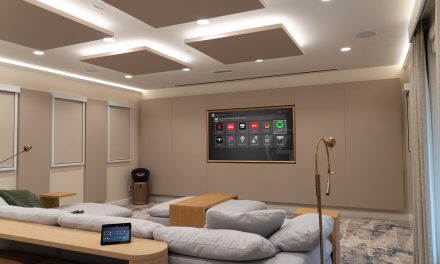
In developing the Q-Series we talked to a lot of dealers and homeowners and asked them about the environments that they’re putting projectors into. And it tuns out they were really interested in more flexible spaces. Sometimes it’s adjoining the kitchen, like a great room. Sometimes it’s a mixed use, multimedia room, game room, that sort of thing. Well, those are not your typical darkroom environments like a dedicated theater would be, and we realized you need to overcome that with brightness. So, taking some of the legacy of what Epson is really good at with 3LCD technology, the light efficiency that Rob spoke about, the brightness that we have, the capability on the commercial side, but now tying that to a residential system with better video processing. So, now we can provide projectors for entertainment spaces that seamlessly blend into the environment.
George: That’s a really important point because everybody I talk to in the dealer and integrator community says there’s kind of a trend away from the dedicated theaters and more towards the multipurpose media rooms that can have a pool table and a bar, or whatever.
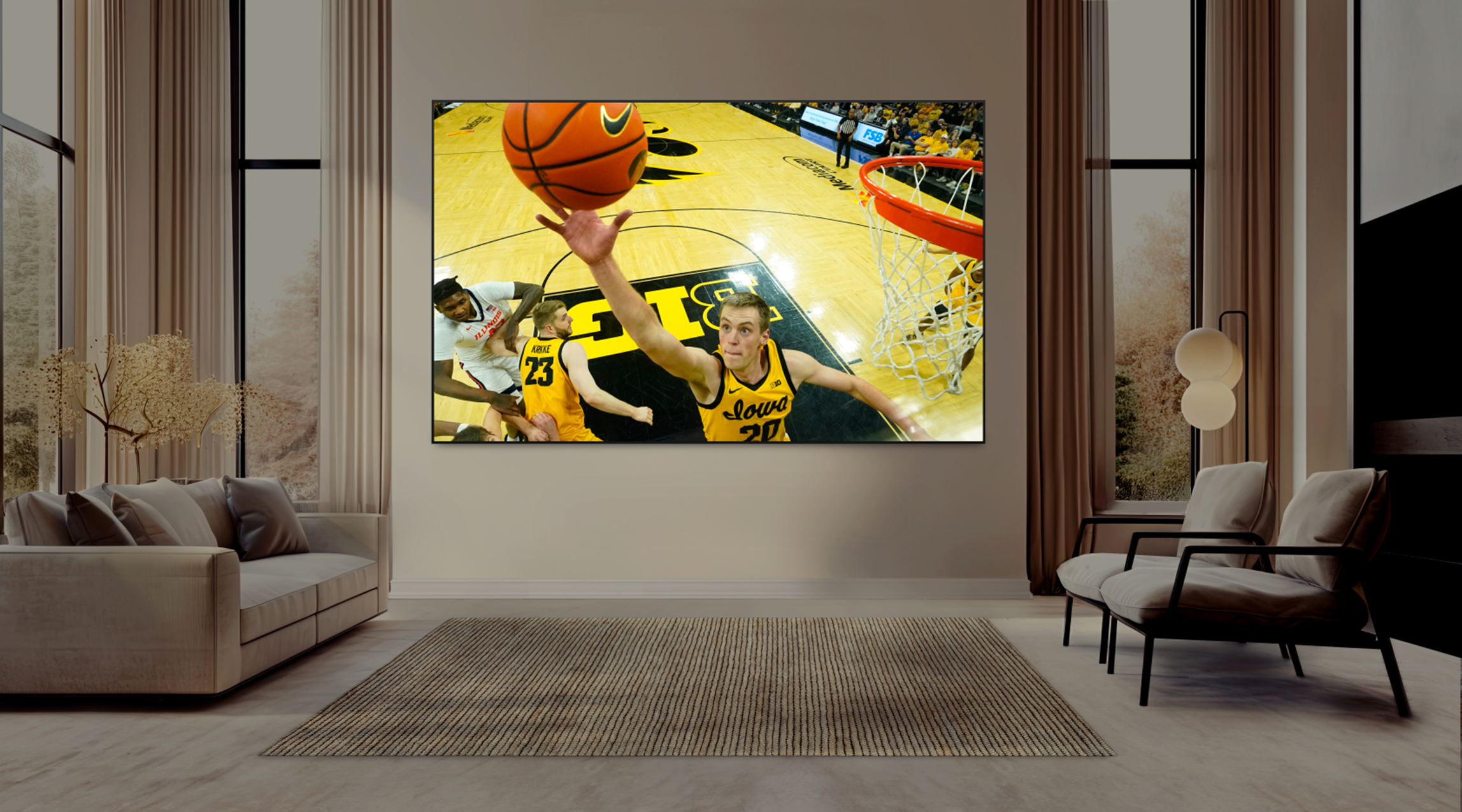
Jason: Yeah. The reality is, when you’re entertaining your friends, you don’t necessarily want to sit in the dark with them. You want to watch the game, and maybe it’s the great room, maybe it’s the flex room or the bonus room. You want a flexible entertainment space where you can have the lights on, have conversations, cheer on the game and so on. In the type of environments where you need projection with higher brightness, we offer the QL3000 ($14,999) at 6,000 lumens, and the QL7000 with 10,000 lumens, which is unmatched at the price point of $30,000.
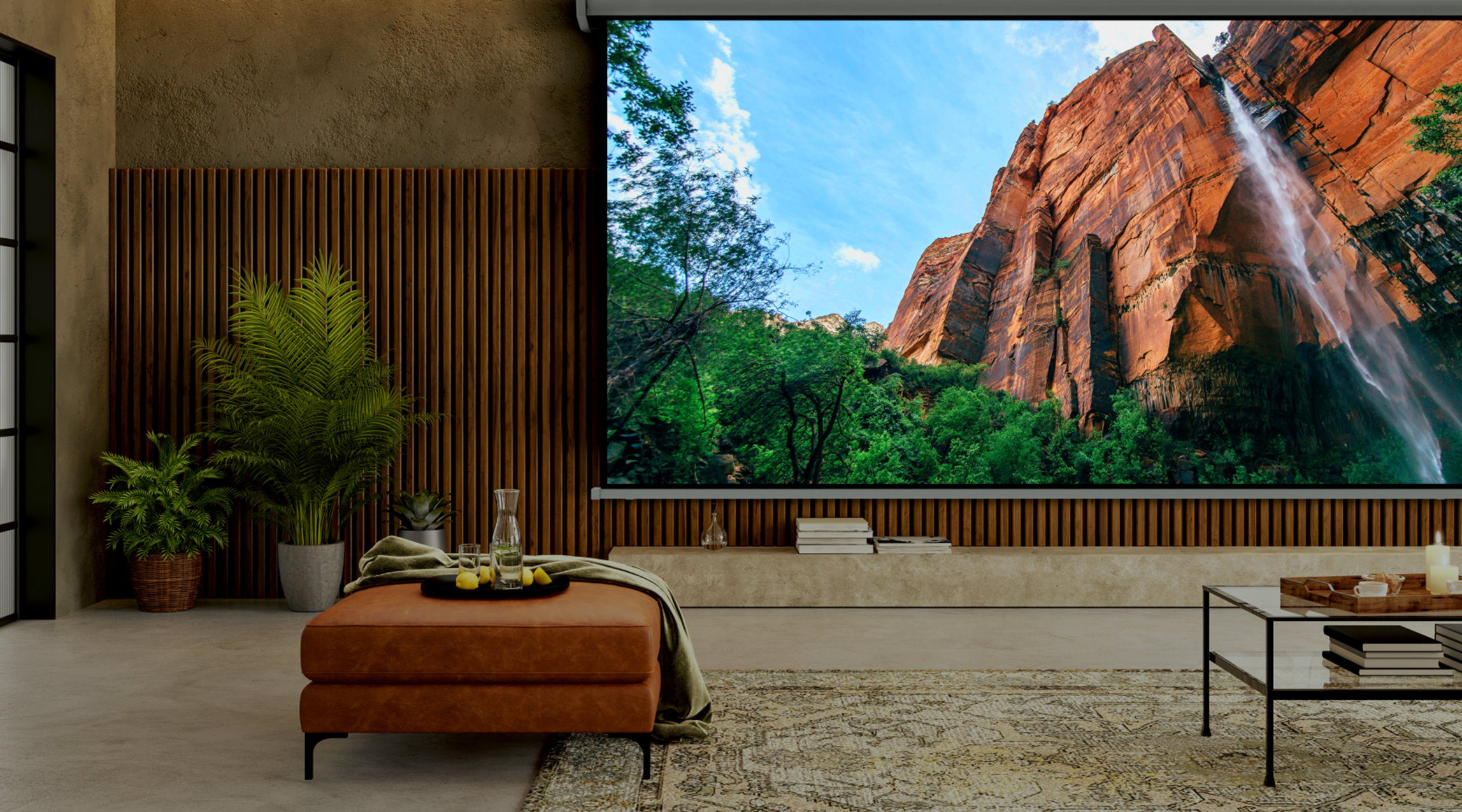
George: I know you had a great demo area of something like this at CEDIA Expo.
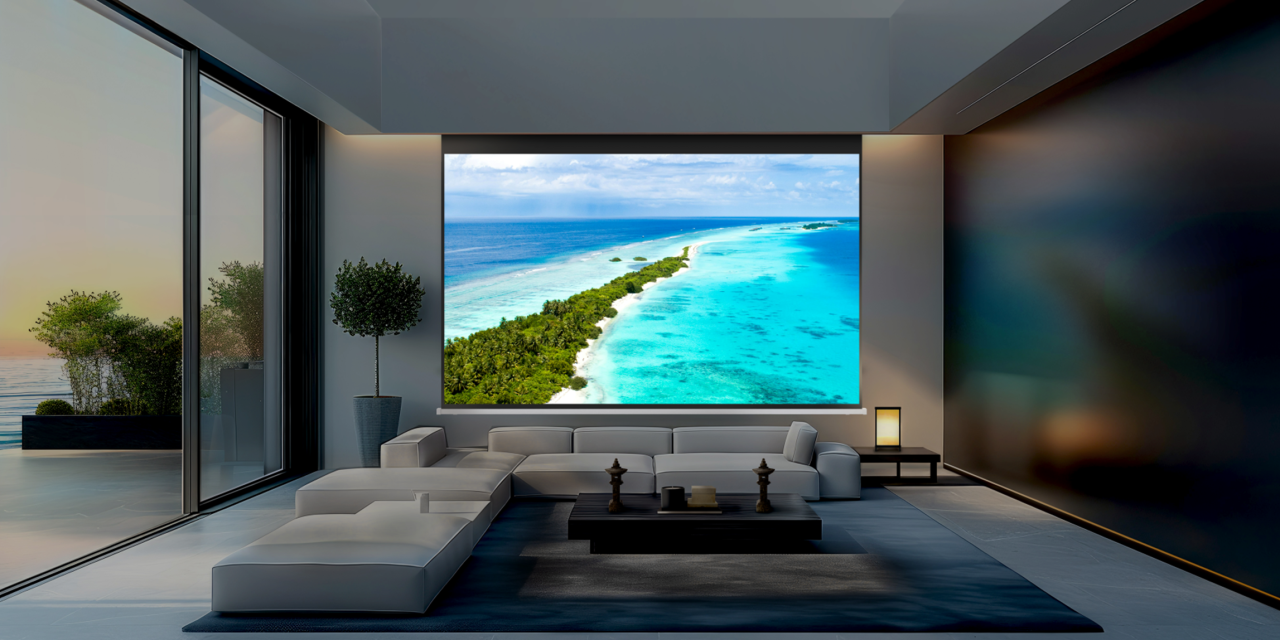
Jason: Yes, we basically mocked up a living room at CEDIA. We had a couch and lights on and lamps and artwork on the wall, and a fireplace and a wall that would typically be where most people would put a television, right? And with the touch of a button, you had 180-inch Stewart Filmscreen projection screen drop down, and the projector comes on and you’re in entertainment mode.
George: Hugely appealing to architects and interior designers to have the video system just entirely disappear rather than be a big black box on the wall.
Robert: Exactly. I want to touch on a couple of other attributes of the Q-Series. Jason mentioned that the QL3000 does 6,000 lumens and the QL7000 does 10,000 lumens. There are other projectors that are available in the market that are at or near those brightness levels. But one of the key things that was important to Epson when we designed the Q-Series is that each projector had to be compact, it had to be quiet, and it also had to have a pleasing kind of design — because not everyone is going to have it hidden in a projector lift. One of the projectors from our primary competitor is about four feet long, about 11 inches tall, and I would say it’s about two-and-a-half feet wide. It operates at around 50 decibels, so it’s quite loud. It also requires an electrician to come in and run a 240-volt setup like your major appliances have to run off of. And it’s also quite hot. So oftentimes people install it in a separate room that then has to have its own HVAC cooling system. And that’s fine if you’ve designed for that, but that’s not common.
The Q-Series on the other hand, is 23 inches by 23 inches, runs off standard 120-volt power, and maximum operating volume is 33 decibels, which is whisper quiet. So, it can be mounted just up in the ceiling. While designers, architects and decorators have had access to this kind of technology for a while now, it’s never been easy. The Q-Series projectors are the easiest way so far to make it happen because of their compact and quiet nature, and the fact that they run off of standard power.
Jason: Yes, we feel that all that makes the interior designer’s job easier. Q-Series projectors are also offered in both black and white, which is a nice option. And another thing I’m going ask Rob to pick up on is our lens options.
Robert: Yes, that’s an important feature. From an industry perspective, the vast majority of projectors do not offer interchangeable lenses. So, when you purchase a projector, you are fixed to the placement. If you happen to be trying to do something custom, you might be out of luck. Typically, when you want to go to an interchangeable lens system, those projectors tend to start in the $60,000 range, and they get very big, very quickly. Some of them are the size of large coffee tables. So that’s where most other manufacturers interchangeable lens options exist. But because Epson has developed technologies for the commercial space for a long time, having flexible installation has always been important.
For the Q-Series, there are 10 different lenses that, for example, could allow you to place a projector from as close as just a couple of feet away. Or it could be placed behind a screen, something we call rear projection. But it could produce that image from just several feet away. Or, on the other end, say you have a very long space to cover, and you don’t want the projector hanging down the middle of the room. With an ultra-long-throw lens option, it can potentially be placed all the way on the other end of the room, even 60-70 feet away. Quite frankly, at these price points only Epson allows that kind of flexibility because basically only Epson has these kind of lens options.
Jason: I’ll give you a quick example, George. We worked with a client in Dallas who wanted to do backyard movie night by his pool but needed the projector in a place that could be concealed and protected from the elements. With an Epson projector and long-throw lens, they were able to create a projector room and project through a glass opening to create an image 70-feet away on the other side of the pool. Again, almost endless flexibility with the lens options.