


By George McClure
Photos: L’Acoustics
The L‑Acoustics foundation is built around the principles of innovation and performance, taking a people-first approach with their operations, remaining environmentally conscious, and educating and elevating their teams and other audio industry professionals, all while supporting their passion for enhancing the arts and technologies.
L‑Acoustics was founded around innovations that revolutionized the professional audio industry. “Simplicity through design” is their pragmatic and avant-garde approach to their technological developments. I recently sat down with Nick Fichte, Global Business Development Lead, Home & Yacht to talk about the company’s amazing new HYRISS solution.

“We believe in the “think global, act local” mantra, so we can support projects all over the world. Another great thing for people to understand is that we have over 1,100 employees in our company, and 20 percent of them work in R&D.”
George McClure: L-Acoustics is well known for professional sound for large venues, and now you’re bringing those professional technologies to the residential space. Please tell us the origin story of L-Acoustics?
Nick Fichte: L-Acoustics was founded in 1984 by Dr. Christian Heil. In the seventies, Christian was fascinated by live sound. He was, and is, a lover of all things music and art. At the time, he was also a particle physicist by trade. But it was his passion for music that led him to where we are today, over 40 years later. He set upon a journey of trying to understand why he could have a great experience listening to music at home, but whenever he went to a live concert, the sound quality always seemed like a bit of an afterthought. I’m not sure if people know the story, but famously the Beatles had to stop touring because they could never be heard over the noise of the crowd.
George: And the screams of the girls [laughs].
Nick: Exactly. That was before Christian began designing loudspeakers. He started to apply physics to loudspeaker design with a real ground-up approach. Rather than just looking at a transducer driver and saying “how can I make this bigger to make it louder”, he looked at the way that sound waves propagated. And that led him onto pioneering the use of line array technology for live events. That’s really where L-Acoustics kicked off in a big way. We had a product that was launched in 1992 called V-DOSC, which very quickly became the industry gold standard for live events. It paved the way for far more interesting stages because it took up less real estate. It made way for video screens. Now, video screens in the nineties obviously aren’t the screens that they are today. But I think when you look at the last two years of Coachella or Adele’s Munich residency last year, that show famously won the Guinness World Record for the largest LED screen. Without this modern line array technology, having that amount of space on stage just wouldn’t be possible. So that’s kind of where the company’s journey began.


George: I know L-Acoustics is based in France, is the manufacturing done in France also?
Nick: Our home office is in Marcoussis, France, which is just on the outskirts of Paris. That is where the global headquarters are, and manufacturing is done. In addition to the R&D teams in France, we have R&D facilities in London and Germany, as well as a London showroom. We have another global headquarters in Westlake Village, California and a warehouse in Camarillo, California as well as offices and a warehouse in Singapore. We’ll also be opening a regional headquarters in Nashville early next year.
We believe in the “think global, act local” mantra, so we can support projects all over the world. Another great thing for people to understand is that we have over 1,100 employees in our company, and 20 percent of them work in R&D.
George: Tell us about your new HYRISS solution.
Nick: About four years ago, there was a project involving a property in the South of France with a large basement space that needed to serve multiple different applications. The previous owners had used it as a nightclub, but the vision was for something more multifunctional. If we create a speaker layout with a grid of loudspeakers, essentially, like you would design a grid of lighting, and we can get the R&D team to work on some technologies, then we can have a space which is completely adaptable. And that was the idea behind HYRISS.
George: Interesting concept.
Nick: HYRISS stands for Hyperreal Immersive Sound Space, which is an evolution of Ocean. [L-Acoustics’ Ocean was a state-of-the-art system with 18 of the company’s celebrated Syva on-wall speakers, 12 overhead speakers and 25 subwoofers, and up to 55,000 watts of power]. Ocean, wherever it was showcased, whether in our showroom in London or our showroom in Los Angeles, always had visible loudspeakers. In London we actually had lights above them to highlight them and show them off.
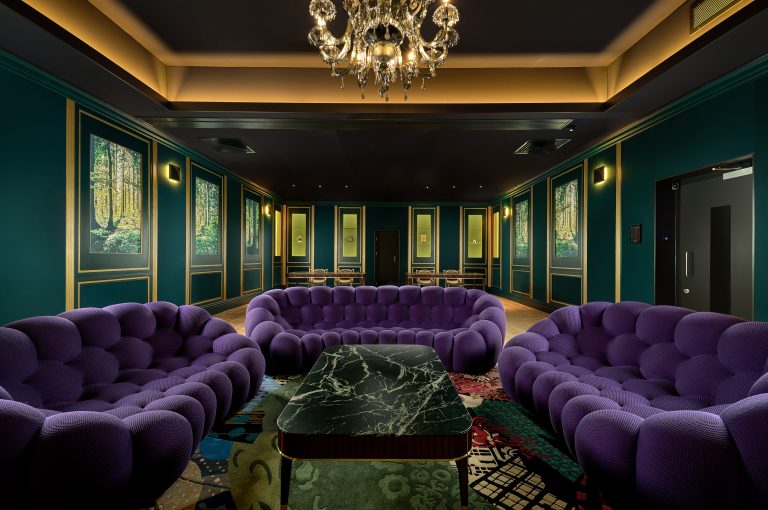
Now, of course, everyone wants to hide everything away, so the cool thing is when you go to our showroom in London and our showroom that’s due to open in the U.S early next year, you don’t see a single loudspeaker, but we actually have more loudspeakers in there than we did previously.

George: So, they’re all in-wall and in-ceiling models?
Nick: Correct. As I alluded to before, I think one of the things that it’s most akin to, and which people can resonate with, is lighting control. You have companies like Lutron and Crestron out there which have been supplying lighting controls for a long period of time. And people really understand the benefits of having different scenes for different times of day and different activities within the home. A kitchen, for example, which is in use all the time, might have a cooking scene, it might have a dining scene, an entertaining scene. Same in a media room, right? That space can be used during the day because the kids are on the couch with their laptops doing some homework, so they need some bright task lighting. But then in the evening it’s mom and dad in there watching a movie, so you want the lights dimmed. What’s special about HYRISS is that it’s as simple to program as a lighting control and can even be tied into the lighting control so that when the homeowner is choosing the action that they’re doing within that space, the system is intelligent enough to be able to adapt to that use. To illustrate: In a traditional home theater layout, you have your left channel, your center channel, your right channel, your surround channels, your rear channels, and you have your height channels.
Now, typically in most spaces, the left, center and right are the bigger speakers. They’re the more powerful ones, because that’s where more of the content is coming from. And then you’re matching your surrounds, your rears and your heights, but they’re probably getting smaller and then smaller again on top.
The idea with HYRISS is that they’re the same loudspeakers all around the space. Then with our software, we can choose exactly where we want that sound to come from. So, say I’ve got a media room and one side of that is a big TV feature wall, that’s quite common, right?
George: Sure.
Nick: If I’m watching a movie, I’m going to want that in Dolby Atmos format as the director intended it. If I’m watching football, that’s probably just going to be in stereo or regular surround sound. I want that sound to seem like it’s coming from the TV. If I’m listening to Dolby Atmos music, I’m probably not going to have the TV screen on, but I don’t want to face a giant black rectangle on the wall, because to the right of me, I’ve got this beautiful view overlooking the pool or the mountains or whatever it may be. With HYRISS, I can turn that Atmos soundtrack 90 degrees and face outdoors and still have the same great sound experience.
Or maybe I want to face a piece of artwork that I’ve got on the other wall, so I rotate at 180 degrees. And then maybe I just want to listen to a Fleetwood Mac vinyl on my turntable. But I don’t want it to feel as if it’s coming from the big back rectangle TV on the wall. I want it to surround me because I’ve got all of my friends around and I want to have this experience where the sound is completely enveloping us. So again, HYRISS processing can spatialize that existing stereo content.
George: That’s really exciting, the versatility of that. I love that idea.
Nick: Yes. Similarly, what if you’re doing a remodel and you want to change your furniture layout within that space. If you had a traditional 5.1 or 7.1.4 speaker system, you’d have to rip all the speakers out of the walls and change the sound system and the orientation of it. You don’t need to do that with HYRISS.

George: So, similar to lighting, you have keypads or controllers where you just push a button to say I want music in this orientation and set that scene?
Nick: Exactly. But instead of scenes, we call them signatures that can be programmed into your control system. And I think any project that would have HYRISS in it is most likely to have a control system in it.
We did a project recently in London in which the clients were avid Sonos users. They just want to pick up their phone, choose their music, and play it. We have it set up so that they can do that. They start with one room orientation, and when they want to change it, they go to their wall touchscreen and they have these different signatures that allow them to add additional features into the room.
Another cool feature, called Ambiance, allows us to create ambient signatures. We can make the space feel like it’s a concert hall, a theater, a cave, a cathedral. Whatever you desire. During a recent visit to our showroom with a group of interior designers, we had this feature turned on and one of the designers told me, “Wow, what a beautiful space. The acoustics in here are just amazing, and not at all what I expected.” Because when you walk in there, it feels as if you’re in a concert hall.
I said, it’s interesting you say that because I hate to break it to you, but this is fake. And she asked, what do you mean it’s fake? I turned Ambiance off, and everyone’s jaws hit the floor, they couldn’t understand how it was possible for the room to be so dead. There’s a hard wooden floor, there are marble tables, there’s glass, there are TV screens, there are all of these reflective surfaces. In the early stages of a project, we pay special attention to room acoustics, so that we know we can start from a blank slate and build flexibility from there. That’s the magic of HYRISS.
George: Sounds like you’re kind of agnostic in terms of control, then?
Nick: Completely. We can integrate with pretty much any control system.
George: What’s the best way to talk to designers and customers about L-Acoustics and HYRISS?
Nick: I think that’s a key point. When we’re involved in these projects, we’re quite thoughtful in our qualification process, because it’s a significant investment of time and collaboration. As you can imagine, a system like this isn’t in the tens of thousands, it’s in the hundreds of thousands. And you could very quickly lose someone’s interest if the value isn’t communicated clearly. It’s important to have the conversation with stakeholders, and I encourage system integrators to use us as a resource. Since the technology is so new, we can share insights from the projects we’ve been involved with and work together to tell the story effectively.
A compelling selling point is to let potential clients know that they’re buying into a brand which is used in mission-critical environments. The processor used with HYRISS is the same processor used for live concerts by artists such as Adele and Janet Jackson. This stuff is mission critical. It has redundancy features built in. If it can run the world’s biggest live shows without fail, it can run your living room.
L-Acoustics also does stereo systems for private residences which can start at around the $15,000 mark. We can do outdoor audio, we can do background music in a kitchen. We can do your home theater. And we can do all of that really, really well, because our products are amazing and perfect for all of those applications.

George McClure is a Senior Editor for Technology Designer Magazine and the Technology Insider Group. Previously, he was the General Manager of Fidelity Communications and most recently a Marketing Manager for Denver-based ListenUp.


