


By George McClure
Sony has a rich history in television, beginning with its first portable transistor TV in 1960 and continued innovations like the Trinitron color TV in 1968, which dominated the market for decades. The company’s history is marked by a commitment to quality, pioneering technology like the Trinitron’s unique aperture grille and three-gun system, and a transition to new technologies like flat-panel LCD and OLED displays under the Bravia brand.
We recently sat down with Kathleen Thomas, Head of Custom Installation (CI) Sales at Sony, to discuss some exciting new developments that will once again push the edge of video display innovation.
One of the cool things at Sony, as opposed to some of the other large companies I see out there is that up at the very, very top we have people that support CI and understand the value of it. Neal Manowitz, President and COO of Sony Electronics North America, started off as an intern at Sony probably much longer ago than he would like us to talk about [laughs].

George McClure: Please tell us about your career path and how it brought you to Sony.
Kathleen Thomas: My career path is very long. I actually had my first job in the industry when I was two weeks old.
George: You were a go-getter!
Kathleen: My joke for my entire career has been, I’ve probably been in the industry longer than you. Which was a little bit funnier when I was in my thirties [laughs]. So, I was in a commercial for the grand opening of Hi-Fi Buys in Atlanta, Georgia in 1973. My parents both worked there, and they later had a rep firm, where I grew up packing literature boxes and answering the phone. When I got out of school with an incredibly useful degree in Art [laughs], I called up my old friends at Hi-Fi Buys and got a job there. I moved to the Pacific Northwest and worked at Magnolia Audio Video, then Sumiko and then to AudioQuest, where I ended up as Vice President of Sales.
Then I joined Bowers and Wilkins, where I worked with Jeff Goldstein, who ended up being my predecessor at Sony. We built out the strategy for custom integration and really changed how Bowers did business with integrators. For most of the Bowers and Wilkins’ history, they were very, very focused on full-range, full-line dealers. If you didn’t carry the full line, you couldn’t be a dealer. We took a different approach, because we realized there are lot of integrators out there that aren’t going to be selling floorstanding speakers at all, but they can absolutely sell architectural speakers. So, we built out a strategy and over the course of a year really transformed that business.
I followed Jeff to Sony and continued to be excited about high performance products. Having studied video production, I understood the ins and outs of what is involved in producing a television show or a film. So, it all fell into place. Jeff and I worked together for a few years, and when he retired we had a plan. It was a smooth transition, and he was very gracious in terms of making sure that I was thoroughly prepared, because not only was it a transition to video, but Sony’s a little bit bigger company than I was used to.
George: That’s great. Let’s dive into what Sony has on tap for TVs in 2026 and some breakthroughs in RGB (Red, Green and Blue) mini-LEDs you’re excited about.
Kathleen: Yes, it’s the culmination of a multi-decade project in RGB technology. Sony actually released our first backlight RGB television in 2004, so this is something that we’ve been working on perfecting for a long time. So, what is RGB TV? Why should I care?
To help understand what makes RGB TVs so special, we need to first look at traditional LCD/LED TVs. They are constructed like a layered cake. We start with the backlight (which is normally white or blue) then have color filters, light guides and diffusers, then the LCD panel. Combining the color filters with the colors in the LCD are how these TVs make all the different colors we see, and these LEDs can be around the edge of the screen or behind the screen, and standard size or shrunk down to just 1/100th the size like mini-LEDs.
With Sony RGB LED, we’re using thousands of these small mini-LEDs that each have a smaller Red, Green and Blue light source in them that we can control individually. That means we don’t need the color filters anymore and can display colors that are purer and brighter than ever.
Over the years, Sony has worked hard to perfect that backlight. So last year we released the BRAVIA 9, which had the most sophisticated backlight that we’ve ever done. It was a huge milestone to get us to where we’re going to be with our forthcoming RGB TVs. What made the BRAVIA 9 so special was we have surface-mounted controllers in each zone on that backlight panel, which gives us 22-bit control in that zone. What does that mean? Well, imagine you have a dimmer on a light switch. The more bits you have, the more levels you have on that dimmer. So, 22-bit is going to give you a lot more gradients in that dimmer and a lot more control over that light output than if it’s 16 bits or eight bits. Having that kind of control is important because it enables you to not have light leakage around objects, which is called “blooming.” It also helps you have better black levels and helps us drive the panel brighter, because we’re not driving as much of the panel at once. So instead of setting everything on blast, we’re able to just drive the parts that need to be bright. It’s incredibly easy to make a bright TV, but what we focused on was this unprecedented level of control to deliver deeper blacks while maintaining details in the shadows, all while delivering the brightest highlights of any Sony 4K TV ever. This dimming control, or algorithm, is shared with our professional mastering monitors that cost over $30K and are used in studios around the world.

George: All great benefits.
Kathleen: When we launched the BRAVIA 9, we had our engineers remove all the LCD layers from the TV so you could see how our processing was controlling all the zones in the backlight. So, if it was a picture of an owl, you saw an owl in black and white. Imagine you have that, but it’s in RGB. Having all those LEDs and being separate red, green and blue lights, it really changes the whole dynamics of the conversation. That said, it does require even more control, so we’re creating brand-new backlight controllers that take us from 22-bit control to 66-bits of control in the backlight. That’s going to be a key factor that separates the new Sony TVs from a lot of the other ones on the market.
By having that level of control, we’re also able to improve off-axis viewing. You may have noticed that if you walk around a TV sometimes it gets dimmer or there’s a color shift when you get off to the side. That’s because you’re really seeing more of the backlight than you are the panel. With Sony’s RGB control, the backlight will light up the color of the object on screen, like the skin tones on the close-up of an actress’s face. So instead of a distracting white or blue backlight washing out her skin tone, it’s the same color as the picture on the TV. The other thing that has been a problem is that blooming, or light leakage, can happen around an object. So, say the image is of a tower with a red light on it against a dark night sky, and historically you may have gotten some kind of white or blue halo around that light. Right? Our new RGB LED TVs will be able to have a red backlight so there is no longer visible and distracting light leaks around the tower.
Our new RGB models are a best of both worlds’ technology: we will have more color volume than current TV while also having much higher brightness and larger screen sizes than is possible with OLED, all while maintaining excellent black levels and shadow details thanks to our backlight control.
George: That sounds pretty impressive.
Kathleen: We’re really seeing it as a revolution in television technology. It’s going to be a paradigm shift in terms of overall television performance.
George: Will you continue to do OLED sets as well or are you just moving to this new technology?
Kathleen: OLED is still an important part of Sony’s mix, and we’ll continue to support it. Our BRAVIA 8 Mark II won “King of TV” this year, it’s the best OLED on the market. We consistently have the best OLED TVs that have won shootouts year after year. This was actually our seventh year in a row of winning that award. But what we see as the runway of performance for the future is with mini-LED and specifically with RGB.
For Sony in particular, it’s about us maintaining that creator’s intent. More than any other manufacturer, we are involved in the content creation business from soup to nuts. We’re there creating the IP [intellectual property] in terms of music, movies, video games and animation. We are there throughout that entire process. We make the microphones, we make the cameras, we make the monitors that most films and television shows are graded on for color grading. And then, of course, we’re there for the reproduction in the home. You know, our C-LED [Crystal LED] video walls were actually originally developed for production and are used as backdrops instead of blue/green screens. For many of the films and TV shows that you watch, Sony products were used all the way through the process, so when something’s being shown on a Sony TV, we know what it’s supposed to look like. We’re able to really recreate everything with the creator’s intent.
George: Tell us a little bit about how you support your dealers and integrators.
Kathleen: Well, it happens on many levels. It starts with the Sony Corporation to make sure that we’re building the right product. I give feedback in terms of features, particularly around control. Making sure that there’s consistency around our tools and control partnerships, and that products are easy to install and reliable. That’s actually a pretty big part of what I do. Also making sure that we have the programs that keep dealers profitable and that they have the support they need. So, working with our reps and our support team and our service team, as well, to make sure that we’re there for any problems that arise. ‘Cause things happen, right?
George: Yes, they do.
Kathleen: And so, it’s how you act when those things happen. We try to make sure that process is as smooth as possible and take care of the customer. We’re also involved in marketing. We have some cool marketing programs where we’ll actually market to dealers’ customers on their behalf, and we manage all of the marketing to make sure that we’re providing a compelling message. Which is important, because a lot of the dealers in our channel aren’t necessarily in a place where they can have marketing departments and things like that. We are giving them some of the tools so that they can have some really compelling national-level marketing to their customers.
George: That’s a real value-added proposition.
Kathleen: Also making sure that they are able to see the product. A lot of our dealers don’t have showrooms or don’t have showrooms with the capacity to see every single product. So, we do annual road shows where we actually take all the product out on the road and invite our dealers in to touch and feel. It’s a great opportunity for them to learn about everything, ask questions, and get information so they can properly convey the message to their customers. We also do CEU [continuing education units] credits for our dealers. We have two CEU courses so that they can invite architects and designers into their store and give those folks some education around working with integrators, how TVs and audio products can properly integrate into a home. We are always looking for new ways to innovate and take care of our customers.
One of the cool things at Sony, as opposed to some of the other large companies I see out there is that up at the very, very top we have people that support CI and understand the value of it. Neal Manowitz, President and COO of Sony Electronics North America, started off as an intern at Sony probably much longer ago than he would like us to talk about [laughs]. But he’s worked at every level, and a big portion of his career was in CI. So, he really understands and cares about the business and is always diligent about making sure that our voice is heard.

George: Is there anything else that you would like the design-build community to know about?
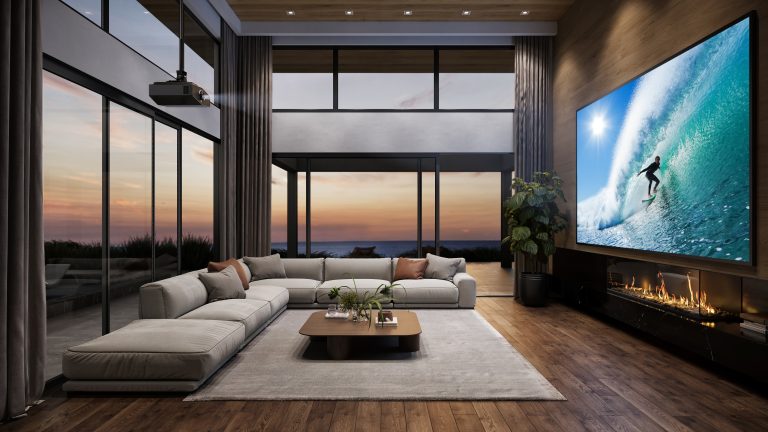
Kathleen: I’d like to remind people that we have a lot of audio products — really the full gamut. And we have great video projectors, which continue to be a thriving business. A lot of times people think of a projector in terms of a dedicated home theater, but really a projector can be used in a bedroom, media room and other applications, as well, as it can be put in a lot of places that you can’t put a TV.
And last, our fastest growing technology is the video wall technology we call C-LED, which I mentioned before. This is probably also our best, what we call “lens to living room” story. It comes directly out of products that were built for video production. You can literally have a 193-inch screen in your home that is the same exact screen that they would use in video production as a backdrop in your favorite series or movies. We’re seeing more and more of those large screens. You know, as conventional flat-screen TVs get larger and larger, you kind of hit a barrier around how big a set that you can actually fit it through a door. The video walls really solve that. There’s a lot of products out there on the market. But Sony’s been making them for a very long time and in terms of image quality and overall performance, it’s a true Sony and really second to none. There’s nothing like sitting in a theater with a 193-inch video wall — it’s pretty amazing.

George McClure is a Senior Editor for Technology Designer Magazine and the Technology Insider Group. Previously, he was the General Manager of Fidelity Communications and most recently a Marketing Manager for Denver-based ListenUp.


