

By Maria Deschamps
Photo: Mallika – Adobe
Anthony Grimani is one of the most influential figures in the world of theater design and acoustics. Over the course of his career, he has held senior roles at Dolby Laboratories and Lucasfilm THX, where he was instrumental in developing Dolby Surround, creating the Surround EX format, and launching the Home THX program. As Founder of PMI Engineering and Grimani Systems, he has developed pioneering loudspeaker and acoustic solutions and today holds seven patents in audio and acoustics.
His passion for education has also left a lasting mark on the industry. Grimani has taught at every CEDIA Expo for more than 35 years, co-authored key industry standards, and continues to influence the way professionals approach acoustics and audio system design.
Along with AVA Systems in Montreal, I had the pleasure of working with Anthony and his team on the Nesly Theater project, where I saw firsthand the depth of his expertise and his collaborative approach. That experience confirmed how much stronger projects become when design and engineering are seamlessly integrated.
In recognition of his decades of innovation, leadership and teaching, CEDIA named Anthony the recipient of the 2025 Lifetime Achievement Award, a distinction that underscores both his technical contributions and his ongoing role as a mentor and industry voice. In our conversation, we explore his views on immersive audio, the challenges of designing media lounges, and the evolving balance between acoustics and design insights that will inspire professionals across the field.

Maria: Anthony, congratulations again on receiving the CEDIA Lifetime Achievement Award. It is such a well-deserved recognition of your decades of contributions to acoustics and theater design. Given that much of your work is highly specialized, what did it mean for you personally to have this recognition from the industry?
Anthony: Receiving the CEDIA Lifetime Achievement Award was elating. It feels good to be recognized for years of work that are often seen by very few. Unlike a film director whose work reaches millions, my projects are typically experienced only by a small circle of people. That’s why industry recognition matters; it acknowledges efforts that can’t easily be shared outside the room, like the Nesly project, where only a handful truly experienced the result.
I also want to emphasize that I didn’t do this alone. My team, colleagues and collaborators have inspired and supported me throughout, and this award reflects that collective effort. This recognition also reflects the progress of the industry. It rewards proper engineering, thoughtful design, and the coordination of everyone involved from system integrators to acousticians, architects, lighting experts and interior designers. I love architecture, I love design, I love intelligent lighting, and when it all comes together, the experience truly elevates.
Maria: Please take a moment to share a little about your background and what continues to motivate your work in acoustics and calibration.
Anthony: My background combines music, engineering, hard work and integrity. My mom was an opera singer, my dad an electrical engineer in telecommunications and audio, so it’s in my DNA. I studied electrical engineering with a focus on communication systems, which led me to Dolby Labs, and then to Lucasfilm THX. Beyond that, what drives me most is creativity and problem solving. Give me a puzzle and I’ll work at it until it’s solved.
I enjoy movies and music, but what really motivates me is solving the issues that make the result clean and accurate. Integrators and designers share that same drive. Every project is new, every problem unique, and that’s why we work so well together. Just as no interior design is ever the same, no theater is ever the same, and that constant problem-solving is what keeps me passionate.
Maria: From your perspective, which technologies are currently having the greatest impact on the evolution of high-end home theaters?
Anthony: I think the biggest impact is the vast, immediate availability of high-quality content. Nobody talks about it, but it’s transformational. Years ago, you had to rent a VHS or DVD, walk the aisles of a store, and settle for mediocre picture and sound. Today, with streaming or systems like Kaleidescape, you can decide in the moment, ‘I want to watch this now’, and instantly access picture and sound quality that was unimaginable back then.
Number two is the ubiquity of immersive audio. What used to be exclusive is now everywhere, with reasonably priced soundbars and audio equipment. It’s unbelievable how accessible it has become.
Finally, number three is the accessibility of large-format displays. You can now buy an 85-inch or 100-inch TV with incredible sharpness and brightness at a price that doesn’t require a second mortgage. Of course, projection is still the reference when properly set up in the right room, but the ability to get a massive, gorgeous image out of a flat panel display has completely changed expectations.
All of these advances are remarkable, but they don’t eliminate the need for professionals. Just as having ingredients doesn’t make you a chef, having access to gear doesn’t mean the system will be designed or calibrated properly. That’s where system integrators come in; like a skilled caterer who not only cooks but prepares for a crowd, they know how to make everything work together so the experience is truly exceptional.

Photo: Michael – Adobe
Maria: Immersive audio formats such as Dolby Atmos have become increasingly standard. How are these formats reshaping the way professionals need to approach overall technical design for a room?
Anthony: When deploying immersive formats like Dolby Atmos, precision is everything. With stereo, you can put speakers almost anywhere, but immersive audio only resolves correctly when placement follows the rules. That’s why CEDIA’s “Recommended Practice 22” (also know as RP22) is so valuable. It’s a 174-page guide detailing proper layout and positioning. You can’t just scatter speakers randomly and expect processing to make it right. You might get close, but it’s never the real thing. To achieve that “transportive effect”, the details matter.
Maria: In terms of displays, what are the key design and performance considerations when comparing traditional projection systems with LED wall solutions? There was a lot of focus on MicroLED video walls were once again demonstrated at CEDIA this year, tell me your suggestions for using this type of video source.
Anthony: When we move from projectors to LED video walls, one important thing to understand is lighting. Even though these displays are bright, you can’t just leave all the lights on. Reflections will still distract from the image, especially in motion scenes, pulling you out of the story.
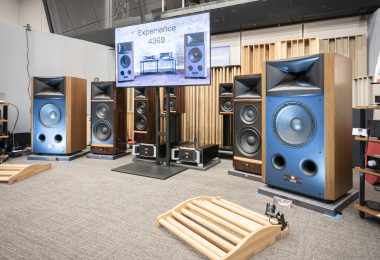
The bigger issue is audio. For the last 20 years, acoustically transparent projection screens have allowed us to place speakers directly behind the image, creating a highly convincing sense of realism. With solid LED walls, that’s no longer possible. Now, center dialogue often comes from above or below the screen, which can make voices sound like they’re coming from someone’s stomach or hair. Left and right speakers can feel too far apart and even surround channels can bounce awkwardly off the hard glass surface.
There are ways to address this, but they require careful planning. With some speakers, you can get adequate results with “phantom center” operation. Other speakers are designed to go up on the ceiling and aim sound down at the listener. Other solutions include dual speakers above and below the screen, combined with special signal processing. Yet another more sophisticated approach is a Reflectance system that projects sound onto the screen and back to the listener’s ear. When done well, dialogue clarity can be restored to the level it should be: crisp, natural and anchored to the image.
Overall, dialogue is the most important element. I sat through several trade show demos where the effects were impressive, but the dialogue wasn’t right, and it undermined the whole experience. If the “meat” of the sound (the voice) isn’t clear, no number of condiments will fix it.
So, video walls are a fantastic technology and simplify the viewing experience, but they come with caveats. The visual performance is extraordinary, but unless the audio challenges are solved properly, you lose the immersive connection that makes a theater truly transportive.

Photo: P11irom – Adobe
Maria: Hidden speakers and architectural acoustics are becoming more prevalent and available. How do you see this trend shaping the balance between visual design and technical performance?
Anthony: Invisible speakers used to be awful, but today several vendors make excellent models. With proper tuning they can sound surprisingly good for background or mid-level music, making them ideal for “media lounges” (spaces that combine living and entertainment) though I wouldn’t use them for dedicated theaters. I’ve worked on many lounges where traditional front speakers handle the main performance while the rest are invisibles, and the result works beautifully.
Architectural acoustics have also evolved. Early absorbers and diffusers looked like lab equipment; big fabric-wrapped panels or clunky grids. Now there are slimmer, more effective treatments that can either look like modern art when exposed or be hidden behind stretched fabric, all while delivering solid acoustic performance. These advances let us integrate acoustics more seamlessly into design.
Maria: As media lounges become popular, what practical steps should designers and integrators prioritize to ensure dialogue clarity and overall intelligibility in these larger, more reverberant spaces
Anthony: Multipurpose media lounges aren’t new, that’s how home theater began before dedicated rooms gained attention in the 1990s. Dedicated theaters still hold steady, but media lounges are growing rapidly as technology becomes more accessible.
The challenge is acoustics. I often see expensive systems installed in big reverberant spaces where dialogue clarity suffers. The key is setting expectations, choosing speakers with constant directivity so sound stays even, and applying equalization and digital signal processing to work around room limitations.
When possible, use new acoustic materials like acoustical plasters, microperforated wood panelling, or design elements that double as absorbers. Even printed art on acoustically transparent canvas can hide sound absorption. These steps can make dialogue intelligible while preserving the aesthetics of flexible spaces
Maria: Which innovations in audio, video or acoustics are you most excited about as you look toward the next 5-10 years?
Anthony: I’m excited about the growing adoption of large direct-view displays. I still enjoy the look of projection, but it requires a fully darkened room, which limits how many people use it. Big TVs and video walls make the experience more accessible, even if they bring new audio challenges.
I’m also excited about the steady evolution of speakers, each year they get a little smaller and easier to integrate while still delivering the power needed for impact. That makes life easier for designers and integrators.
The real gain I see is in how all these technologies; slimmer speakers, more compact displays, smarter electronics, make it easier to create rooms that look like a clean slate. When the gear disappears visually, the movie becomes the focus, and that’s when the magic happens
Maria: Finally, what key takeaways would you offer to professionals in our industry? How can they best guide their clients toward future-ready, acoustically sound, and aesthetically successful home theaters?
Anthony: First takeaway, keep learning. No matter how much experience you have, there’s always more to know about acoustics, video, lighting, design and now even AI. Carve out time each week to study, attend conferences and stay curious.
Second, don’t act like the star of the show. Act like the director. A great theater is the result of a team that includes integrators, acousticians, lighting and interior designers. The role of the professional is to coordinate those talents, not to grandstand.
Third, let the experience sell itself. The best way to guide clients is with a demo. In five minutes, they’ll understand the value of immersive sound and picture more than through any technical explanation.
In the end, keep learning, act like a director, show the experience and frame budgets realistically. That’s how professionals deliver future-ready, acoustically sound and aesthetically successful theaters.

Maria Deschamps is an innovative interior designer, naturally bridging the gap between technology and aesthetics, redefining spaces with a global touch. Splitting her time between the vibrant design scenes in L.A. and Montreal, she draws inspiration from diverse cultural influences to create immersive and exclusive environments.